MQL vs SQL: what's the difference and why it matters
An MQL (Marketing Qualified Lead) is a lead that marketing believes is worth a sales conversation. An SQL (Sales Qualified Lead) is a lead that sales has confirmed is worth pursuing. The gap between them is where most B2B revenue gets lost.
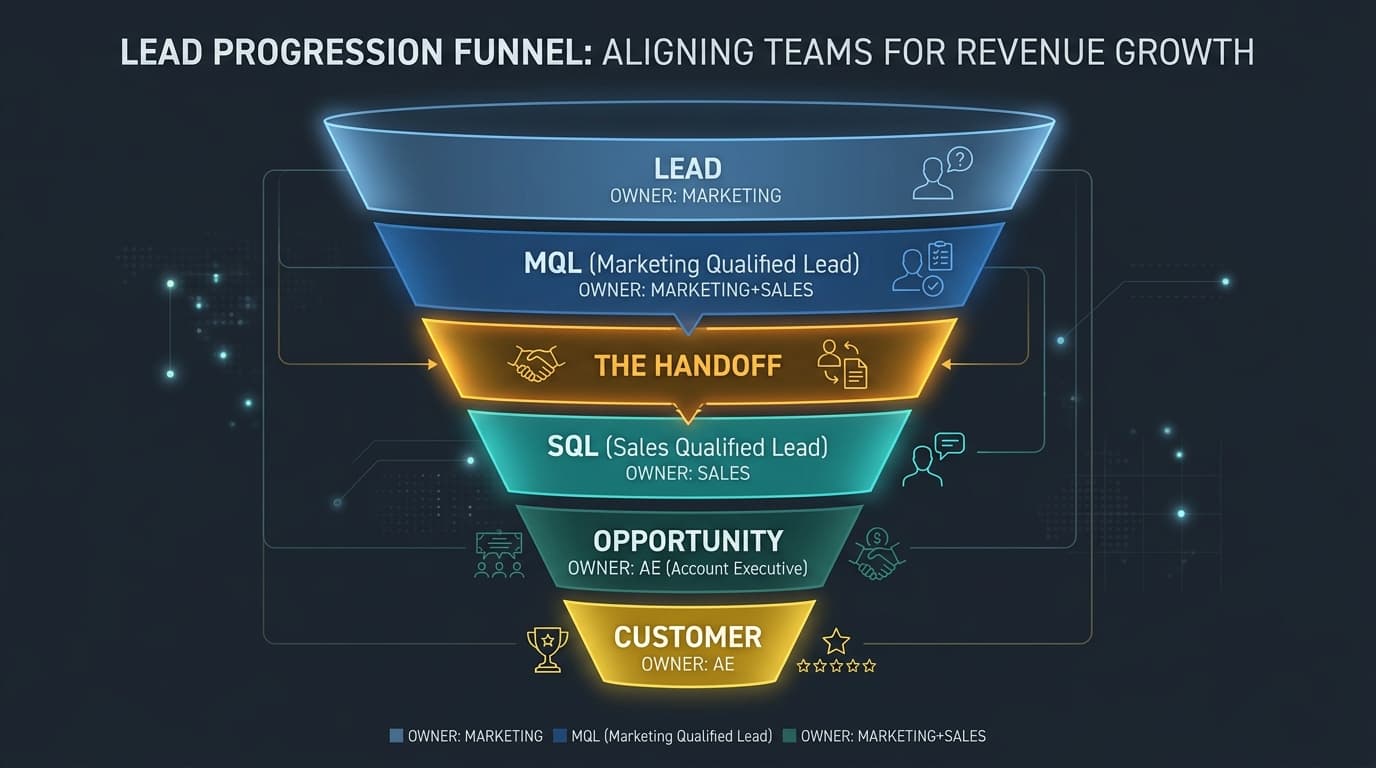
An MQL — Marketing Qualified Lead — is a lead that meets the criteria marketing has set for passing to sales. An SQL — Sales Qualified Lead — is a lead that sales has reviewed and confirmed is worth actively pursuing. They sound like consecutive steps in the same process. In practice, the gap between them is where the most common revenue loss in B2B companies happens.
How MQL is typically defined
Most companies define MQL using a lead scoring model: a combination of fit criteria (company size, industry, job title) and engagement signals (page visits, content downloads, webinar attendance, email clicks). A lead that hits a threshold score becomes an MQL and gets handed to sales.
The problem: most MQL definitions are optimised for marketing's metrics, not for what actually closes. A lead from an ideal-fit company that downloaded a whitepaper looks like a strong MQL. It might be a grad student doing research. MQL status says something about behaviour, not about buying intent.
How SQL is typically defined
An SQL is a lead that a sales rep — usually an SDR — has contacted and confirmed meets the basic qualification criteria: they have the problem, the authority, the budget range, and some timeline to buy. Most teams require a connected conversation (call or email reply) before marking a lead as SQL.
Some companies add an intermediate stage — SAL (Sales Accepted Lead) — for the moment the SDR picks up the lead and agrees it's worth calling, before confirming qualification. That's mostly an organisational distinction. The material definition is: SQL means sales has confirmed the opportunity is real.
Where the gap creates revenue loss
When MQL-to-SQL conversion is low — typical range is 10-25% — you have one of three problems: the MQL definition is too loose, the SDR follow-up is too slow, or both. Marketing is proud of its MQL volume. Sales is frustrated by poor lead quality. Neither has an incentive to fix the actual problem: the MQL definition doesn't reflect what actually buys.
Response time matters more than most teams acknowledge. Studies consistently show that leads contacted within 5 minutes of form submission are 9x more likely to convert than leads contacted after 30 minutes. MQLs from a webinar that get called 3 days later have materially lower conversion than the same leads called same-day.
What a healthy MQL-to-SQL process looks like
Good sales alignment means sales and marketing agree on the MQL definition together, based on historical data about what actually converts to closed-won — not on what's easy to measure. MQL scoring gets reviewed quarterly and updated when conversion data shows it's off. And SDR follow-up happens within hours, not days.
How AI agents handle MQL-to-SQL conversion
AI SDRs close the response time gap completely — they can follow up on an inbound MQL in minutes, not days, because they don't have a queue of calls. More importantly, they apply a consistent qualification checklist on every contact, so SQL conversion doesn't vary based on which rep picked up the lead. The MQL-to-SQL handoff is one of the highest-ROI places to apply AI in a B2B GTM system.