How long it actually takes an AI SDR to outperform a human SDR
An AI SDR doesn't outperform a human SDR from day one — it outperforms at month 3 and accelerates from there. Here's the performance timeline, what drives it, and why the gap compounds over time instead of flattening.
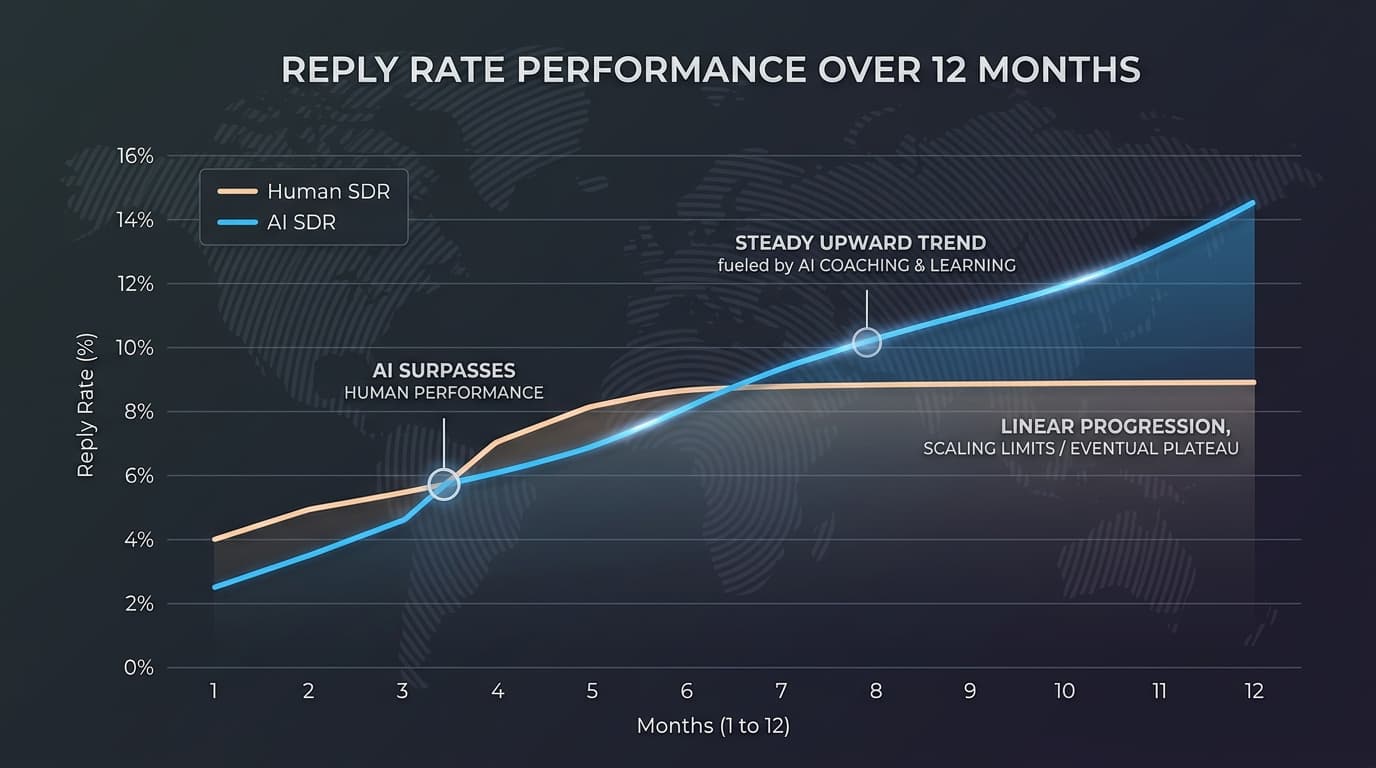
An AI SDR does not outperform a human SDR from day one. It starts slower. A well-configured AI SDR — with tight ICP, proven messaging, and a supervisor coaching loop in place — matches a fully ramped human SDR by month 3. By month 6, with compounding memory from coaching cycles, it consistently outperforms. The gap then widens, not narrows, over time.
What does month 1 performance look like for each?
Month 1 human SDR: still onboarding. Learning the product, the ICP, the tools, the competitive landscape. Output is below target. Most teams budget 2–3 months before expecting meaningful pipeline contribution. Month 1 AI SDR: executing from day one, but without the coaching feedback loop that makes it improve. Reply rates in month 1 reflect the quality of the initial brief — typically 3–5% for a reasonably defined ICP, which is already competitive with a junior human SDR in early ramp.
Why does the AI SDR performance accelerate at month 3?
By month 3, three things have happened. The ICP definition has been refined based on which accounts actually replied. The supervisor (Ektie's Sales Director agent, Orion) has written coaching notes based on what worked and what didn't — and those notes are now part of the agent's persistent memory on every cycle. And the sequence structure has been adjusted based on which steps generated the most replies. A human SDR at month 3 is just reaching full ramp. The AI SDR at month 3 is running a smarter playbook than it ran at month 1.
What does month 6+ look like?
In sequences run when using Ektie's agents, month 6 performance reflects 5 months of accumulated coaching. The agent is running differentiated messaging by ICP segment, applying research signals that proved effective in earlier sequences, and using break-up email timing calibrated to when non-responders in this specific ICP tend to re-engage. Reply rates of 10–12% on well-defined ICPs are achievable at this stage. A human SDR at month 6 is fully productive — but their improvement curve has flattened. They learn from individual experience, not from systematic memory accumulation.
What's the honest case for a human SDR over an AI SDR?
High-ACV enterprise deals that require live phone calls, real-time objection handling, and complex multi-stakeholder coordination. A skilled enterprise BDR navigating a Fortune 500 buying committee is doing something current AI SDRs can't replicate. For sub-$30K ACV deals where the bottleneck is volume, consistency, and memory — not live conversation skill — the performance comparison favours AI by month 3 and grows from there.