Clay vs Apollo: data enrichment depth vs outbound reach
Clay and Apollo both help with prospecting, but they're fundamentally different tools. Clay enriches and personalises data with waterfall logic. Apollo gives you a database with a built-in sequencer. Here's when to use each — and how they work together.
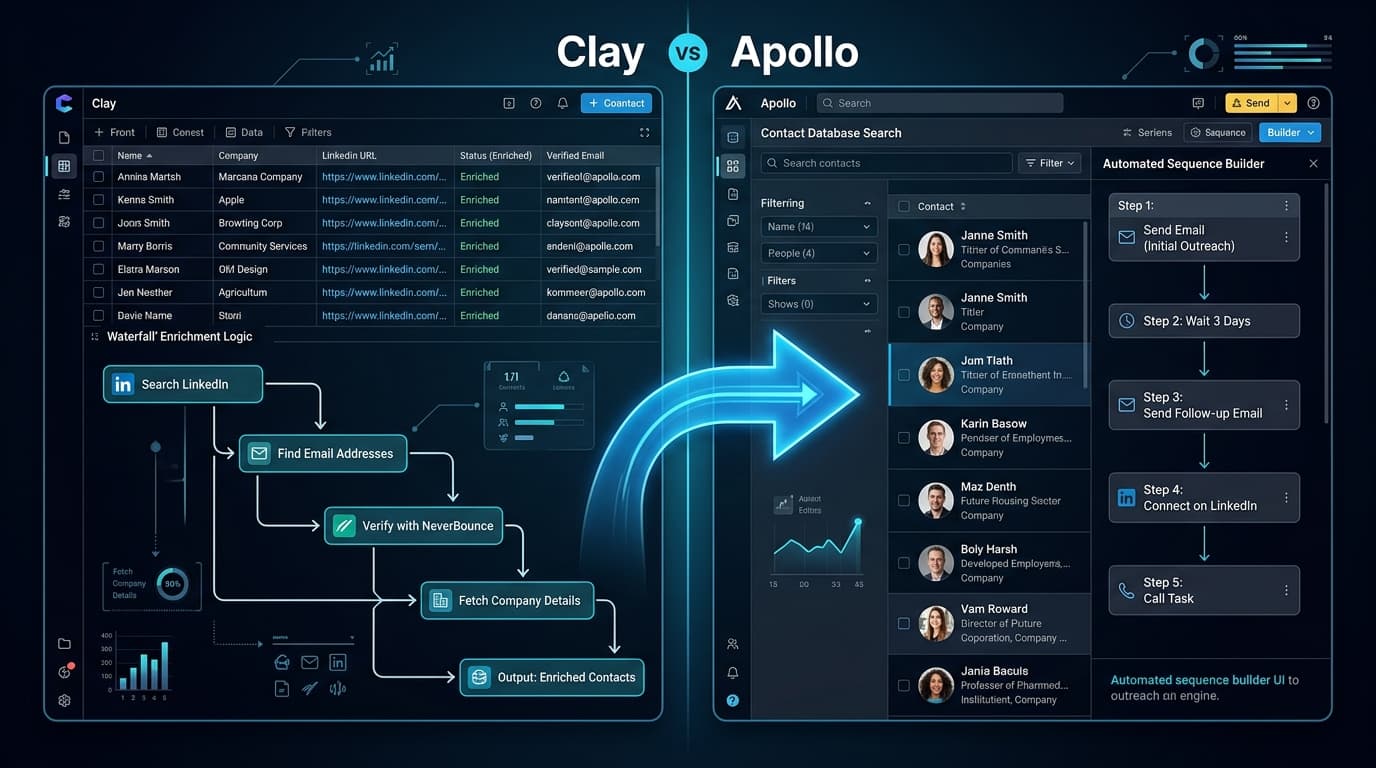
Clay and Apollo are not competing for the same use case, even though both get mentioned in the same outbound conversation. Clay is a data enrichment and personalisation platform — you build the logic that assembles account intelligence from multiple sources. Apollo is a prospecting database with a built-in sequencer. One prepares data for outreach. The other executes it.
What does Clay actually do?
Clay pulls contact and company data from dozens of sources — Apollo, LinkedIn, Clearbit, Hunter, Crunchbase, and others — using waterfall enrichment logic: try source A first, if it fails try source B, then C. The result is a data table with richer, more verified contact information than any single source provides. Clay also runs AI enrichment: generating personalised email openers, researching recent news about a company, extracting specific signals from a prospect's LinkedIn profile. It's a research and enrichment tool, not an outreach tool.
What does Apollo do that Clay doesn't?
Apollo is a database. You filter by ICP criteria and get a list of contacts with email addresses and direct dials. It also has a built-in sequencer — you enrol contacts directly into email cadences from within Apollo. For teams that want a single tool that handles both prospecting (finding people) and outreach (contacting them), Apollo does both without requiring integrations.
Which is better for personalised outbound?
Clay produces higher-quality personalisation data. The waterfall enrichment and AI research capabilities generate email openers and account context that Apollo's built-in personalisation features can't match. But Clay doesn't send emails — you export the data to a sequencer. Apollo's personalisation is weaker but the workflow is tighter. If personalisation quality is the priority, Clay wins. If workflow simplicity is the priority, Apollo wins.
How do many teams use both?
Clay builds the list and enriches each record with account research, recent news, and AI-generated personalisation signals. That enriched data exports to Apollo (or Ektie) for sequence execution. You get Clay's enrichment quality without giving up a sequencer. The combination is more setup than either tool alone, but for teams where personalisation is a meaningful reply rate driver, the lift is worth the workflow complexity.