The complete guide to AI sales automation
AI sales automation in 2026 means more than automating email sends. This guide covers everything: what it actually is, how the categories differ, how to choose between them, and how to build a motion that compounds over time.
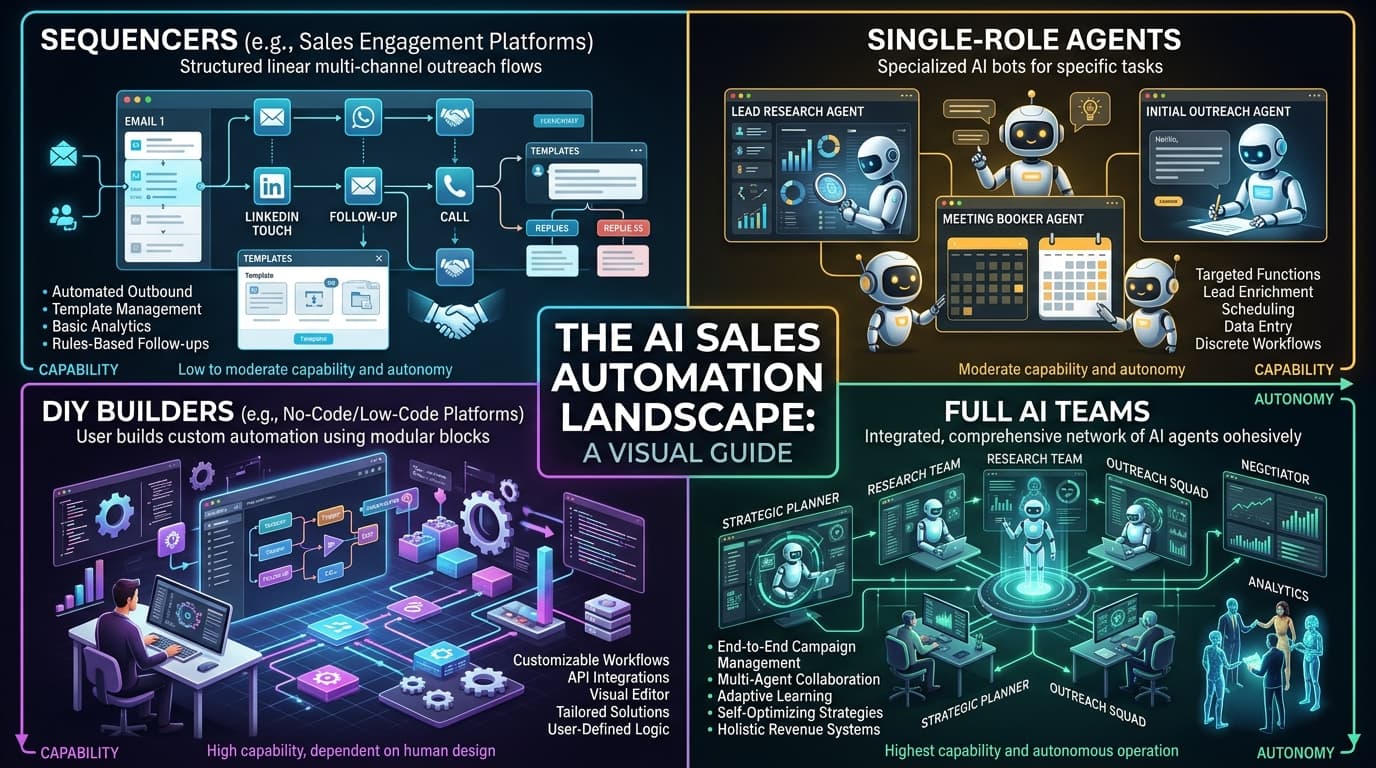
AI sales automation has become one of the most overloaded terms in B2B software. It describes everything from a sequencer that sends emails you wrote to a fully autonomous AI team that prospects, outreaches, follows up, and manages pipeline without being prompted. The gap between those two things is enormous.
This guide covers what AI sales automation actually means, the four distinct categories of tools, how to choose between them, how to implement it, and — most importantly — how to build a motion that compounds rather than resets every cycle.
What does AI sales automation actually mean?
True AI sales automation means the AI acts — it doesn't just assist. A chatbot that helps you write a better email is not sales automation. A system that finds your ICP-fit prospects, researches each one, writes personalised outreach, sequences them, follows up automatically, and hands warm replies to your AE is sales automation.
The key distinction: does the AI execute tasks without being prompted, or does it help you execute tasks faster? The first is automation. The second is a productivity tool.
What are the four categories of AI sales automation tools?
Category 1 — Sequencers with AI features. Tools like Apollo, Lemlist, Instantly, and Outreach automate the sending and follow-up of sequences you build. AI additions can generate drafts and suggest subject lines. You still build the list and write the core message. This is automation of the sending layer, not the prospecting or research layer.
Category 2 — Single-role AI agents. Tools like Artisan, 11x, and AISDR run autonomous outbound — finding prospects, writing personalised outreach, managing sequences. They operate independently on the SDR role. The limitation: there's no team around them. Warm replies get handed to a human AE with no automatic context transfer. No memory layer that compounds.
Category 3 — DIY builder tools. Clay, Make, LangChain, and similar tools give you components to build an AI sales system. Powerful and flexible. You need real technical depth to build it and time to maintain it. The quality of the output depends entirely on whoever built the system.
Category 4 — Full AI GTM teams. A coordinated team of agents — SDR, AE, Marketing Manager, Ad Manager, supervisors — running on shared memory with built-in hand-offs, delegation, and coaching. Every outcome feeds back into the team's memory before the next cycle. This is the closed-loop model.
What actually makes AI sales automation work?
Persistent memory. An AI agent without memory resets every session. It can't apply coaching from Monday to what it does on Friday. It can't learn which ICP segments reply faster or which objection handling works. Memory is what separates an AI agent from a fancy template generator.
Closed-loop execution. Every outbound action produces a signal. Every signal should feed back into how the next cycle runs. Open-loop systems execute and record — nothing changes. Closed-loop systems execute, observe, and adapt. This is what makes an AI sales motion compound rather than plateau.
Heartbeat execution. AI agents that run on fixed recurring cycles — every 60 to 180 minutes — produce consistent output regardless of whether a human is present. This is what breaks the burst-and-stop outbound cycle most founders fall into.
Native hand-offs. In a multi-role system, the SDR handing off to the AE automatically — with full context — is what makes the team work as a team rather than a collection of individual automations.
How do you choose the right approach?
You already have SDRs and want to improve sequences: sequencer with AI drafting. You need outbound to run autonomously without SDR headcount, and have human AEs: single-role AI SDR. You're technical, want full control, and can build and maintain it: Clay or agent framework. You want the full GTM execution layer to run — outbound through to pipeline and ads — without building it: AI-native GTM platform.
Implementation: what to do in the first 30 days
Week 1: Define your ICP in one sentence. Configure the AI with your product description, target market, and messaging approach. Don't overthink it — it's a hypothesis you'll refine.
Week 2: Watch the first outreach cycle. Review what the agent produces. Write 3–5 coaching notes — what landed, what missed the mark. These go straight into the agent's persistent memory and change what it does next cycle.
Weeks 3–4: Review reply patterns. Which segments are responding? Which subject lines are getting opens? Refine the ICP based on what converts. Write more coaching notes. The agent gets sharper.
Month 2+: The compounding begins. By week 8, reply rates are typically 2–3x what they were in week 1 — not because you rebuilt anything, but because 30+ coaching cycles accumulated and the loop kept closing.
The mistake that kills AI sales automation
Automating before validating. If the ICP is wrong or the message doesn't land, an AI agent runs fast and produces nothing. Validate first: get 5–10 customer conversations manually, confirm the pain is real, confirm the message resonates. Then automate the motion you've proven. AI amplifies a working process. It doesn't create one.
Dive deeper
What is an AI SDR — the full definition and how it differs from a sequencer. What is a heartbeat agent — how the recurring execution cycle works. How do AI sales agents learn over time — the memory architecture. How does coaching an AI agent work — from plain English to persistent memory. Inbound vs outbound sales — the difference between the two motions and when to use each. AI SDR vs human SDR — cost, ramp time, memory, and judgment compared. Best AI SDR tools in 2026 — the four categories and how to choose. AI agents vs chatbots for sales — the fundamental architecture difference.