CRMs only work when someone maintains them. Nobody does.
Everyone has a CRM. Almost nobody maintains it properly. Here's why bad CRM data is worse than no CRM — and why the solution isn't better discipline.
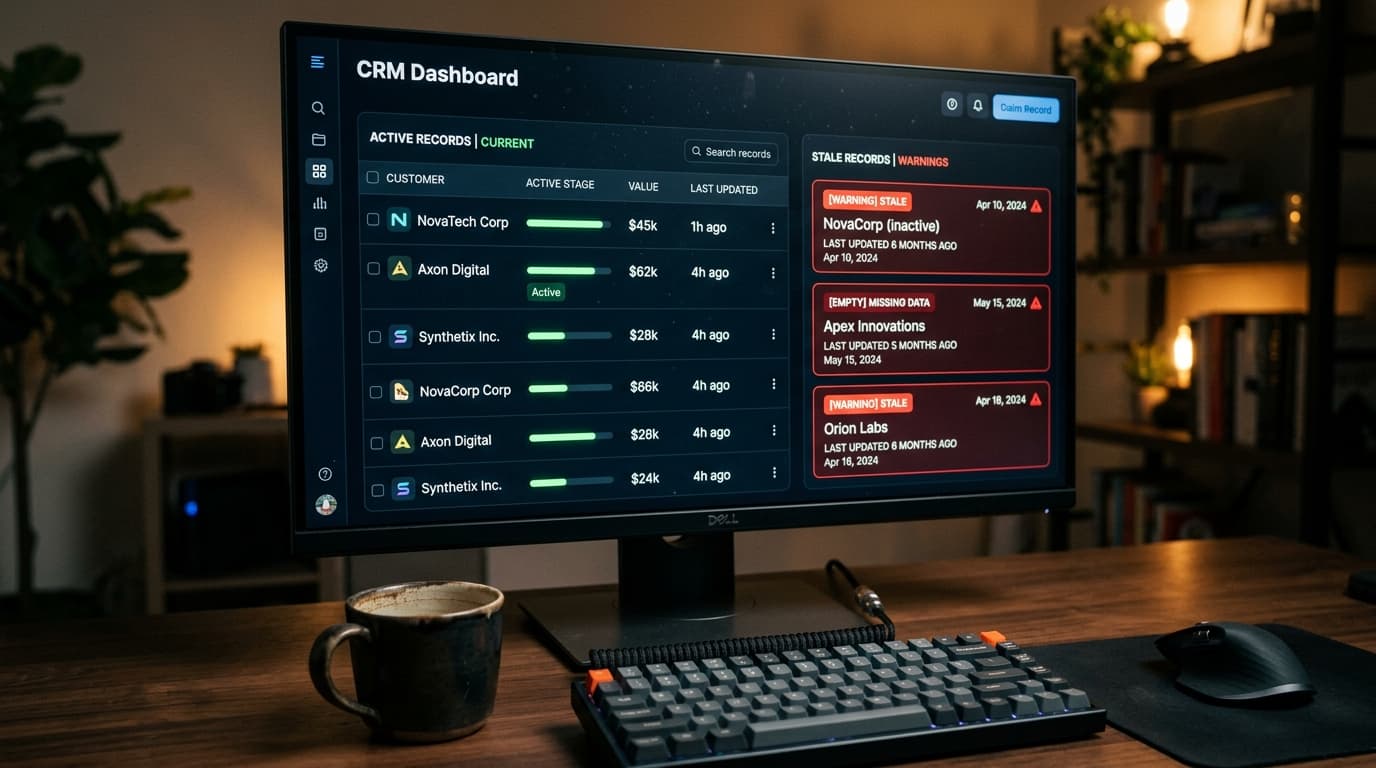
Most B2B companies have a CRM. Almost none of them have a well-maintained one.
This isn't a failure of ambition. Sales teams intend to log calls. AEs intend to update deal stages. Marketing teams intend to keep contact data current. But intentions collapse against the reality of a small team with too much to do. The call goes unlogged. The deal stage doesn't get updated. The contact's role changes and nobody notices for six months.
The result is a CRM that looks full but contains mostly noise. And that's actually worse than having no CRM at all.
Why a bad CRM is worse than no CRM
With no CRM, you know you don't have visibility. You're honest about the gap. You make decisions cautiously because you know you're working from incomplete information.
With a half-maintained CRM, you have false confidence. You run a report and make decisions based on it. You trust the pipeline numbers even though half the deals haven't been touched in three weeks. You reach out to a "warm lead" who left the company four months ago. You brief a new SDR on an ICP that was accurate in Q3 last year and hasn't been updated since.
The data exists. The data is wrong. And you don't know which parts are wrong, so you can't compensate.
The discipline problem can't be trained away
Every sales leader I've seen tackle this goes through the same progression. They implement a CRM hygiene policy. They make data quality a KPI. They run monthly audits. Things improve for a quarter, then regress. The urgency fades. The team gets busy. Logging gets deprioritised again.
This is because CRM maintenance competes directly with selling. Every minute an SDR spends logging a call is a minute they're not making the next one. Every minute an AE spends updating a deal stage is a minute they're not working the deal. The incentives are structurally misaligned.
You can't train your way out of a structural incentive problem. If maintaining the CRM requires human discipline applied consistently against competing priorities, it will eventually fail. Every time.
What AI features on a CRM don't fix
The obvious response from CRM vendors has been to add AI features. Auto-summarise calls. AI-generated next steps. Predictive lead scoring. These are genuinely useful — at the margin.
But they don't fix the data quality problem. Auto-summaries are only as good as the calls that get logged. Predictive scoring is only as accurate as the records it's scoring. A chat interface on top of stale data just lets you ask questions about unreliable information faster.
AI features on a legacy CRM are optimisations on a broken foundation. The data quality problem sits one level below where the AI operates.
The only fix that actually works
The problem with CRM implementation is that maintenance requires a human to do it as a separate task from the work itself. The fix is to make the maintenance happen as part of the work — automatically, attributed, with no additional human effort.
When an agent prospects a company, the research is written back to the CRM record automatically. When a sequence step executes, the activity is logged immediately. When a deal advances, the stage updates in the same cycle. When a follow-up is sent, the contact record reflects it.
This isn't a discipline problem. It's an architecture problem. A CRM maintained by agents who act through it — rather than humans who are supposed to log into it afterwards — stays current by design. Not by policy.
What changes when the CRM is actually accurate
When your CRM is actually accurate, everything downstream works better. Pipeline reports reflect reality. Handoffs carry real context. Forecasts are based on real deal progression. Coaching is based on what actually happened, not what someone remembered to write down.
Most companies treat CRM quality as a behaviour problem to be managed. It's actually an architectural question about who — or what — is responsible for keeping the records current. As long as the answer is "the sales team, in their spare time," the quality will always drift.