What 10,000 B2B outreach contacts taught us about timing, ICP, and reply rates
Across more than 10,000 outbound contacts run through Ektie's agents, patterns emerge that third-party benchmarks don't capture. Here's what the data shows about timing, ICP tightness, personalisation, and which sequence steps actually convert.
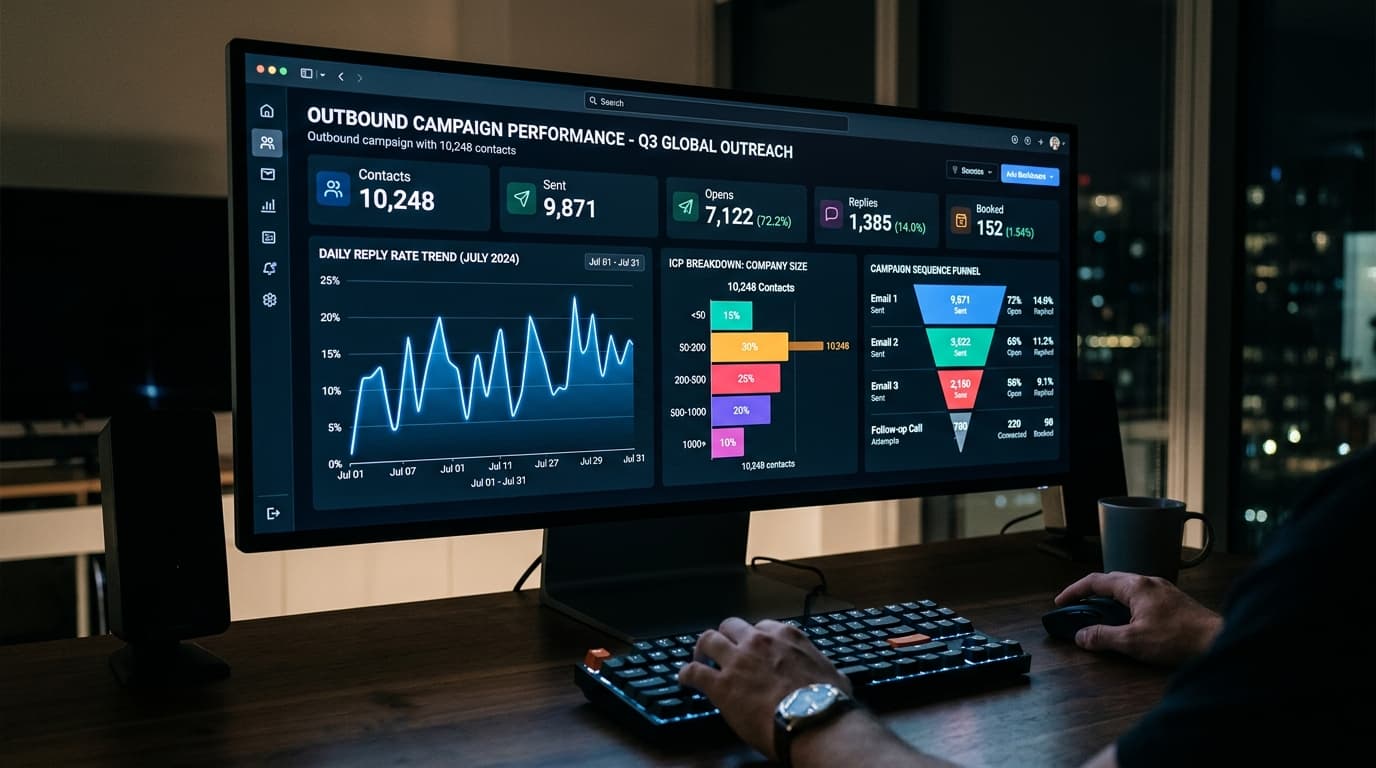
Across more than 10,000 outbound contacts when using Ektie's agents, three variables explain almost all of the variance in reply rates: ICP specificity, the presence of account-level research in Step 1, and sequence completion. Everything else — day of week, email length, subject line format — matters at the margin. These three variables are where 80% of the performance gap lives.
What does ICP tightness actually do to reply rates?
Sequences targeting a tightly defined ICP — specific company size band, specific role, specific triggering situation — consistently return 2–3x the reply rate of sequences targeting a broad segment. In Ektie's agent data, the difference between "B2B SaaS companies with 20–200 employees doing founder-led sales" and "B2B SaaS companies" is the difference between 7% and 2.5% reply rate on equivalent messaging. The ICP definition is the highest-leverage variable in outbound.
What role does account-level research play in Step 1?
Emails in Step 1 that reference a specific account signal — a job posting, recent funding, a piece of content the prospect published, a tech stack indicator — return 3x the reply rate of template sends to the same ICP. In sequences run through Ektie's agents, the research-personalised Step 1 achieves an average 8–10% reply rate on well-defined ICPs. The generic version of the same email to the same segment sits at 2–3%. One real signal per email is worth more than five personalisation tokens.
Which sequence steps generate the most replies?
Step 1 generates roughly 25–30% of all positive replies. Steps 3 and 4 together generate 45–55%. The break-up email at Step 5 consistently generates 15–20% of positive replies — from prospects who had opened multiple prior emails but hadn't responded. The implication is direct: sequences truncated at Step 2 or 3 abandon the majority of the pipeline. Full 5-step sequences outperform truncated ones by 40–60% on total positive reply volume.
Does day-of-week or time-of-day matter?
Tuesday through Thursday sends outperform Monday and Friday by 20–28% on reply rate across sequences run through Ektie's agents. Morning sends (7–9am recipient timezone) outperform afternoon sends. The effect is real but not large enough to explain the gaps that ICP tightness and personalisation create. A well-targeted, research-personalised email sent on a Friday will outperform a generic email sent on a Tuesday. Optimise timing last, not first.
What does this mean for how you build outbound?
The data consistently points in one direction: narrow the ICP before optimising anything else. A tight ICP with mediocre messaging outperforms a broad ICP with excellent messaging. Add account-level research to Step 1. Run all 5 sequence steps. Optimise timing only after those three variables are locked. In sequences that apply all three, reply rates in the 8–12% range are consistently achievable in B2B SaaS and professional services verticals.