How to price a B2B SaaS product
B2B SaaS pricing is part art, part math. Most founders underprice by 30–50% because they anchor to what feels comfortable rather than to what the value delivered justifies. Here's the framework for setting prices that capture value without losing deals.
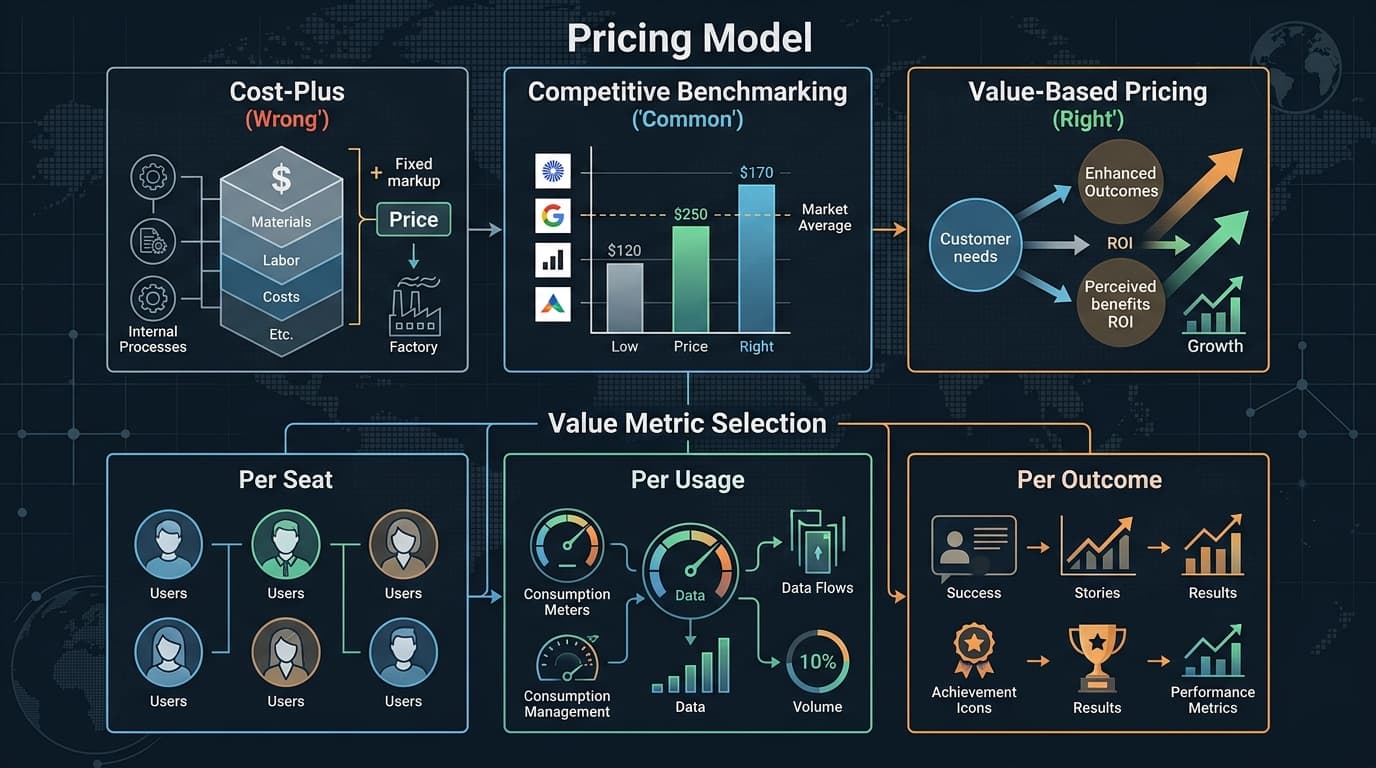
Most B2B SaaS founders underprice their product by 30–50%. Not because they misjudged the market — because they anchored to what felt defensible rather than to what the value delivered actually justifies. A product that saves a VP Sales 10 hours per week and generates $50K of additional pipeline per quarter is not a $50/month product. Pricing reflects the value you believe you deliver. Low prices signal low confidence before you've said a word.
What is value-based pricing and how do you use it?
Value-based pricing sets the price based on the value the product delivers to the customer, not on your costs or competitor prices. The process: quantify the outcome for the buyer. If your product saves a founder 15 hours per week of GTM work, and a founder's effective hourly rate is $200, that's $3,000/month of time value — before any revenue impact. The price should be a fraction of that value, typically 10–30%, which puts the justified range at $300–$900/month. Most founders are pricing at $99.
How do you choose a value metric?
A value metric is the unit that scales with the customer's usage and perceived value. Per seat works when each additional user gets proportional value (CRM tools, collaboration tools). Per usage works when value tracks with consumption (AI credits, API calls, email sends). Per outcome works for products where value is tied to results (a percentage of revenue generated). The wrong value metric creates misalignment between your revenue and the customer's value — per-seat pricing on a product the team uses rarely, for example, feels expensive regardless of absolute price.
How should you structure pricing tiers?
Three tiers is the standard for B2B SaaS. A starter tier that gets small teams to a first meaningful outcome — limited features, lower price, designed to convert rather than to be sticky long-term. A growth tier that contains the core product value — this is where most revenue comes from. And an enterprise or scale tier with advanced features, support, and security that enterprise buyers require. The key: each tier should represent a genuinely different buyer profile, not just feature gating for its own sake.
How do you know if your pricing is wrong?
Three signals. You're closing almost every deal without price objections — your price is too low. You're losing deals consistently at the proposal stage with "too expensive" — either the price is genuinely too high for the ICP or the value wasn't established before the proposal arrived. Your best customers are on the cheapest tier — packaging is wrong, the starter tier is over-featured relative to what it costs. Pricing is never permanently correct — review it every 6–12 months against these signals.