How to write a B2B case study that closes deals
Most B2B case studies are too generic to close deals. They describe what the product does, not what the customer's specific problem was, what they tried before, and what changed after. Here's the structure that turns a case study into a sales asset.
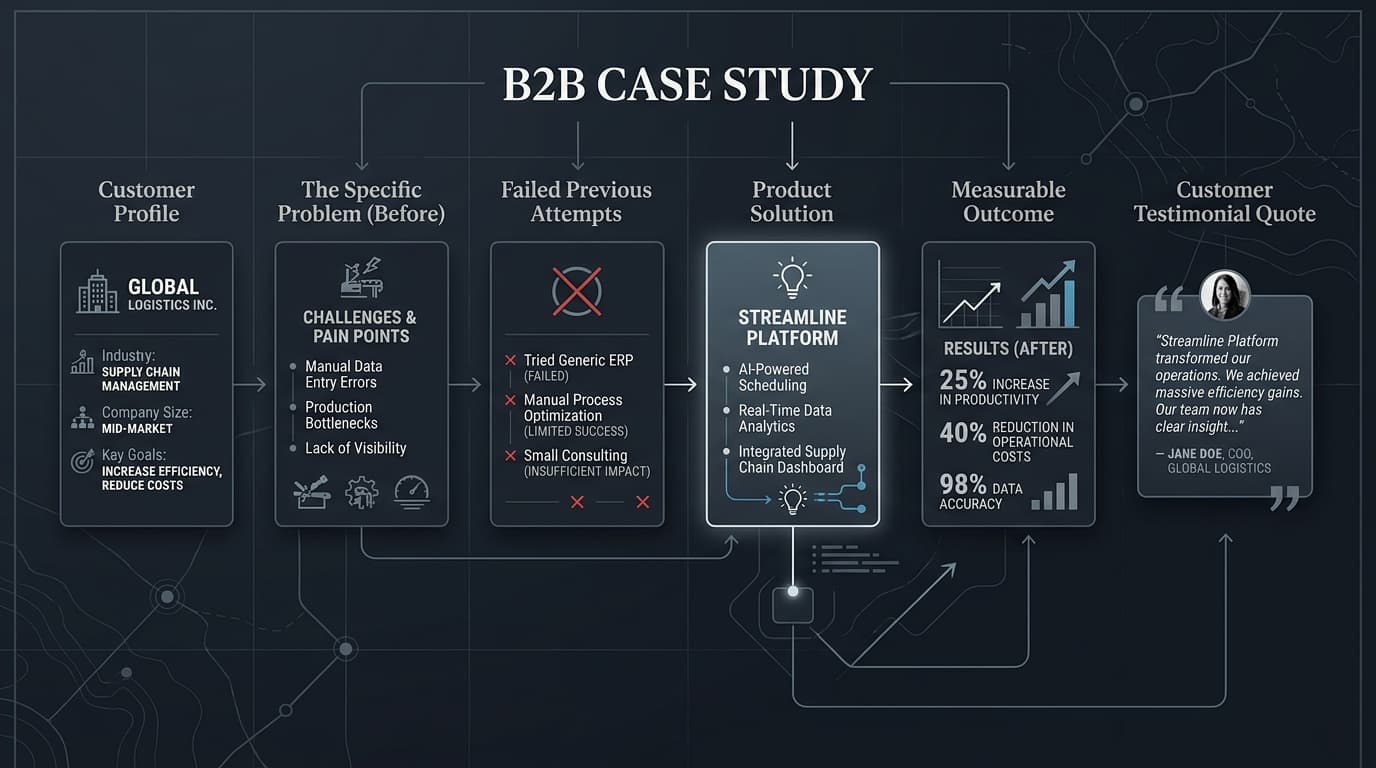
Most B2B case studies don't close deals because they're written to impress rather than to persuade. They describe what the product does and gesture at positive outcomes without specifics. A case study that closes deals tells a specific story: here's who the customer was, here's the specific problem they had, here's what they tried before that didn't work, here's what changed after implementing the product, and here's a specific number that proves it.
What is the right structure for a B2B case study?
Six sections. Customer profile: who they are, company size, industry, role of the person quoted — specific enough that the reader sees themselves in the customer. The problem: the specific situation before. Not "they needed to improve their outbound" — "they were generating 3 meetings per week, needed 10, and had just lost their SDR with no budget to replace them." What they tried before: this is the most underused section and the most valuable — it makes the problem feel real and acknowledges the alternatives. The solution: how specifically the product addressed the problem. The outcome: one or two specific numbers — "12 meetings per week within 60 days, 3 of which closed in the quarter." The quote: a sentence from the customer in their voice that summarises the outcome.
Who should you interview for the case study?
The champion — the person who drove the purchase decision and has the most vivid before/after perspective. Not the executive who signed off. Not the VP who approved the budget. The person who was living the problem before and is living the solution now. They give you the specific language, the specific pain description, and the quote that feels real because it is. Executives give you corporate language. Champions give you human language.
How do you get specific numbers when customers are hesitant to share?
Ask for ranges rather than absolutes. "We went from 3 to 12 meetings per week" is not confidential. "We saw approximately 4x improvement in meeting volume" is the same number in a form most customers will approve. If they won't share revenue impact, ask about time saved, headcount avoided, or process improvement. A number doesn't have to be revenue to be persuasive — "saved 15 hours per week of founder time" is often more relatable to the
Ask for ranges rather than absolutes. "We went from 3 to 12 meetings per week" is not confidential. "We saw approximately 4x improvement in meeting volume" is the same number in a form most customers will approve. If they won't share revenue impact, ask about time saved, headcount avoided, or process improvement. A number doesn't have to be revenue to be persuasive — "saved 15 hours per week of founder time" is often more relatable to the ICP than "$47K in pipeline created."
Where should a case study live and how should it be used?
On the website for SEO and inbound trust-building. In the sales sequence as a Step 2 or Step 3 touchpoint — sent to prospects who match the customer profile featured. In the demo call when a prospect has a specific concern the case study addresses. In the proposal as proof of outcome. The mistake: writing a case study and putting it on the website and never using it in the sales process. The case study's highest-value role is in the middle of the sales cycle, not at the top.