Sales automation for recruiting agencies: running two pipelines at once
Recruiting agencies run outbound in two directions simultaneously: sourcing candidates and developing client relationships. Here's how sales automation handles both pipelines without creating confusion between them.
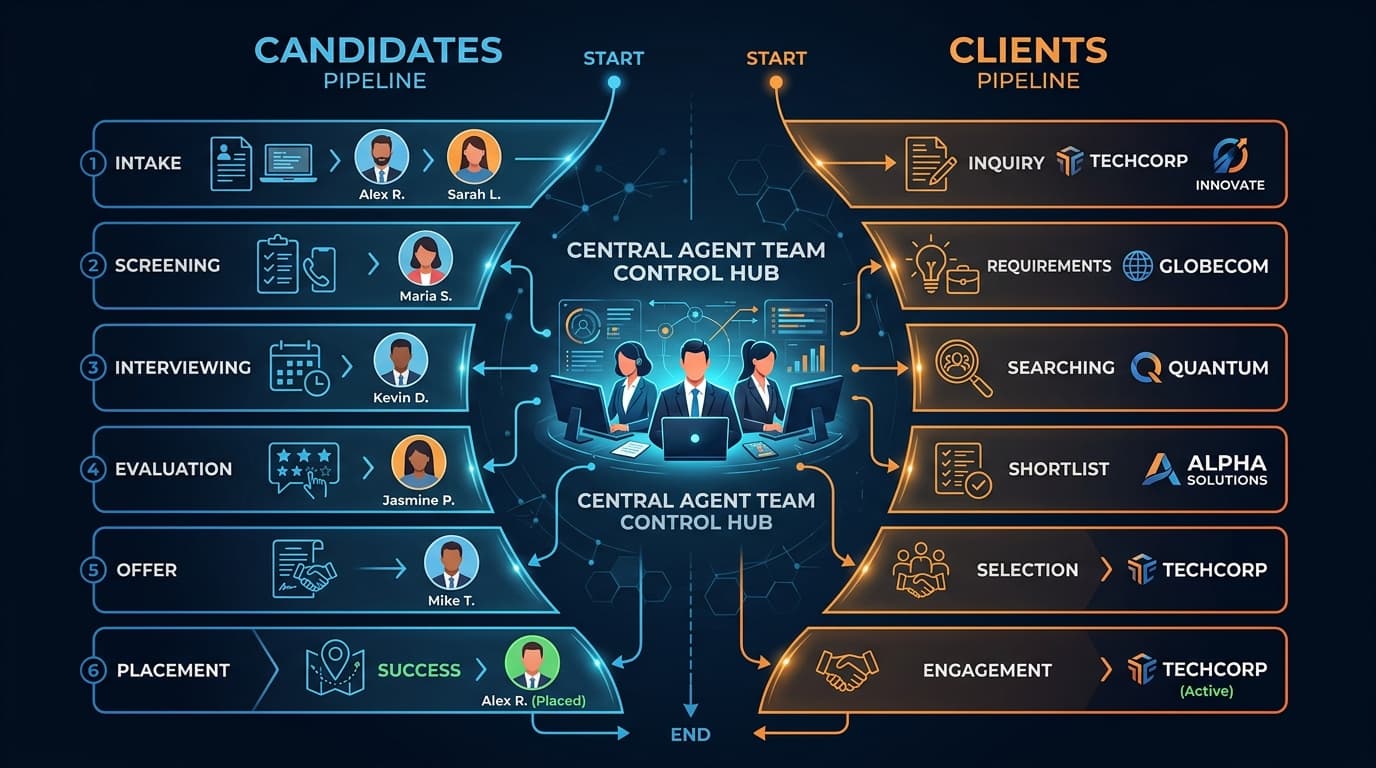
Most recruiting agencies run two outbound motions simultaneously: one to source candidates, one to develop client relationships. The problem isn't effort — it's that both pipelines stall the moment recruiters get busy filling roles. Sales automation keeps both running independently, without requiring recruiters to context-switch between them.
Why does running both pipelines manually fail?
Candidate sourcing needs daily LinkedIn prospecting, personalised outreach referencing the candidate's experience, and multi-touch follow-up. Client development needs outreach to hiring managers, messaging that leads with placement speed and specialisation, and sustained follow-up over weeks. Neither pipeline tolerates gaps. When a recruiter is heads-down on a placement, both go quiet.
When recruiters get busy filling open roles, both pipelines stall. Candidate pipeline dries up. Client development stops. The boom-and-bust cycle typical of recruiting is largely a pipeline consistency problem.
How does candidate sourcing automation actually work?
LinkedIn is the primary channel. An AI SDR configured for candidate outreach identifies profiles matching role criteria (title, experience level, company type, location), visits and engages with recent posts to create a warm signal before connecting, sends a personalised connection request referencing their specific background, then follows up after acceptance with the role brief. The whole sequence runs on autopilot for each open role.
The ICP for candidates is specific to each open role. Each role gets its own configured outreach track so messaging doesn't get mixed.
How does client development automation work differently?
Client development targets hiring managers and talent acquisition leads at companies that hire in your niche. The trigger is active job postings — a company posting three senior engineering roles is a warm signal. An AI SDR running a client track finds those postings, routes to the decision-maker, opens with a brief on your agency's specialisation, and follows up with placement examples and turnaround times. Concrete proof points, not a pitch deck.
How do you keep the two pipelines from bleeding into each other?
Each pipeline runs in its own track with separate ICP definitions, separate messaging, and separate CRM objects. Coaching applied to the candidate track — say, "always reference a recent placement in the same tech stack" — stays scoped to that track. Per-workspace isolation means client data and candidate data never share the same view. Recruiters log into one system and see two clean, distinct pipelines.
What recruiting agencies actually gain from this setup
Both pipelines run every day regardless of whether your recruiters are busy with placements. Sourcing doesn't stop because someone's closing a deal. Client outreach doesn't stop because the team is interviewing candidates. Recruiters focus on interviews, client relationships, and placement negotiations — the parts that need a human. The outbound runs without them.