SDR vs BDR vs AE: what's the difference?
SDR, BDR, and AE are three distinct sales roles that often get confused. They cover different parts of the pipeline, have different metrics, and require different skills. Here's exactly what each does and where each fits in a B2B sales org.
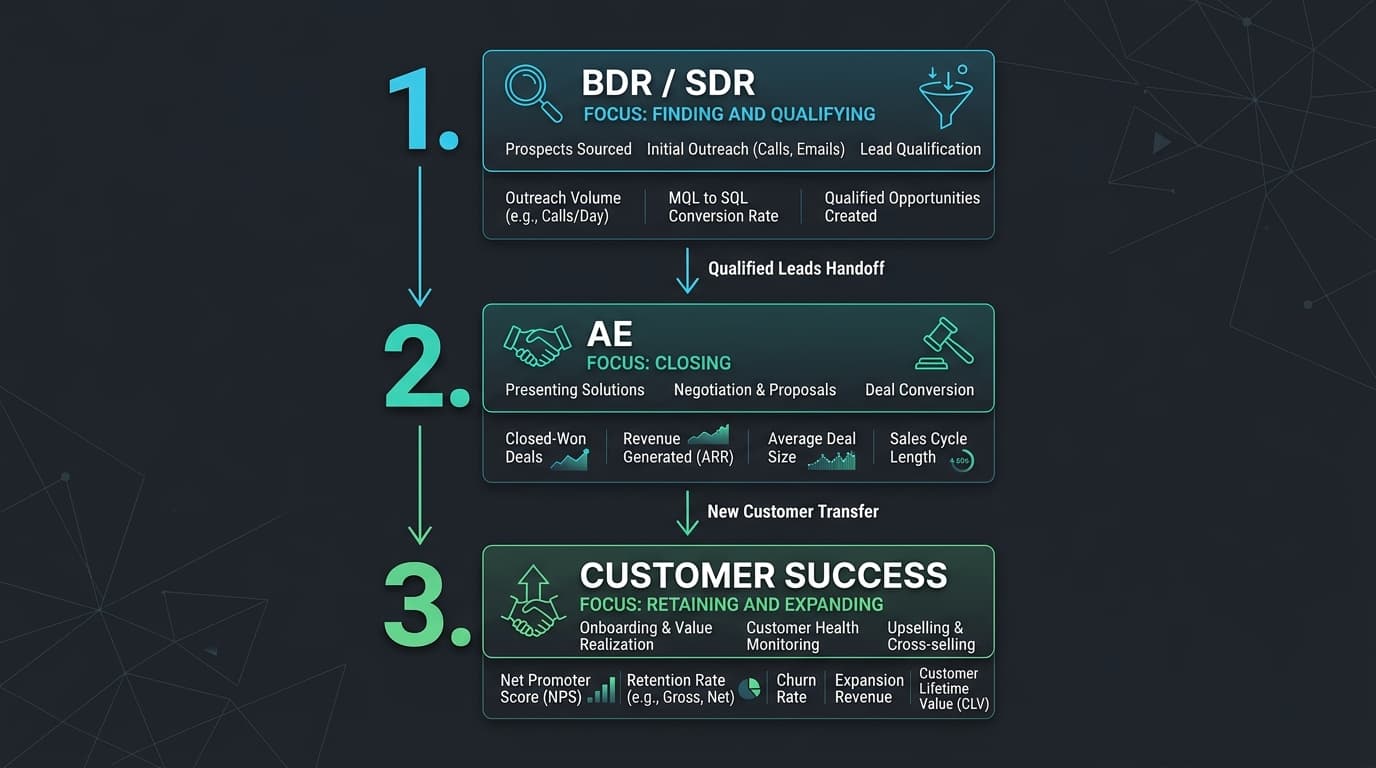
SDR, BDR, and AE are three B2B sales roles that cover different stages of the pipeline. They're often confused with each other — especially SDR and BDR, which some companies use interchangeably and others distinguish sharply. Here's exactly what each role does, how each is measured, and where each fits.
What does an SDR do?
An SDR (Sales Development Representative) focuses on outbound prospecting — finding companies that match the ICP, reaching out cold, qualifying interest, and booking discovery calls for Account Executives. SDRs don't close deals. Their job ends at a booked, qualified meeting.
SDR metrics: meetings booked per week, show rate, pipeline generated. A fully ramped SDR books 8–15 qualified meetings per week. Ramp time is typically 2–4 months.
SDRs typically report to the VP of Sales or a Sales Development Manager. They work closely with AEs to understand what constitutes a qualified lead — a misalignment between SDR qualification criteria and AE expectations is one of the most common GTM problems.
What does a BDR do?
BDR (Business Development Representative) is used two different ways depending on the company:
Definition 1: BDR = SDR. Many companies use BDR and SDR interchangeably. Same job, different title. If you see both roles at the same company, they typically mean the same thing.
Definition 2: BDR focuses on inbound, SDR focuses on outbound. In this model, BDRs handle leads that come in through the website, trial signups, event leads, or marketing campaigns. SDRs do the cold outbound. The distinction reflects different skill sets — inbound qualification vs. outbound prospecting.
Definition 3: BDR handles strategic partnerships, channel development, or enterprise account development. Less common but used at some larger companies.
When you see both titles at the same company, ask which definition they're using — it varies.
What does an AE do?
An AE (Account Executive) picks up where the SDR/BDR leaves off. They run the discovery call, understand the prospect's situation, demo the product, manage a proof of concept if required, handle objections, write the proposal, negotiate terms, and close the deal. AEs own the revenue number.
AE metrics: quota attainment (revenue closed), average deal size, win rate, sales cycle length. A typical mid-market AE carries $500K–$1.5M in annual quota depending on deal size and industry.
How the three roles work together
SDR finds and qualifies the lead → books a meeting → AE runs the discovery call → AE closes. The handoff between SDR and AE is critical and often broken. When it works: the SDR passes full context (what the prospect said, what their pain is, why they agreed to the call), and the AE shows up already informed. When it doesn't: the AE shows up cold, asks the same questions the SDR already asked, and the prospect wonders why they're talking to two different people. How many SDRs should support each AE is a structural question that directly affects pipeline quality — the SDR-to-AE ratio determines whether AEs are starved for pipeline or overwhelmed by it.
How AI changes the SDR/AE model
AI SDRs (like Morgan in Ektie) fully replace the outbound prospecting and qualification function of the human SDR role. The handoff to the AE is automatic — when Morgan books a meeting, Astra (the AI AE) picks it up with full context from every prior touch. No manual handoff. No context loss.
What AI doesn't replace: the senior relationship judgment an experienced AE brings to complex, high-stakes deals. AI handles the volume, the consistency, and the early-stage qualification. Humans handle the deals where nuance matters.