What is BANT? The sales qualification framework explained
BANT is a sales qualification framework: Budget, Authority, Need, Timeline. A prospect that scores well on all four is worth pursuing. One that fails on more than one is worth deprioritising. Here's how to apply it — and where it breaks down.
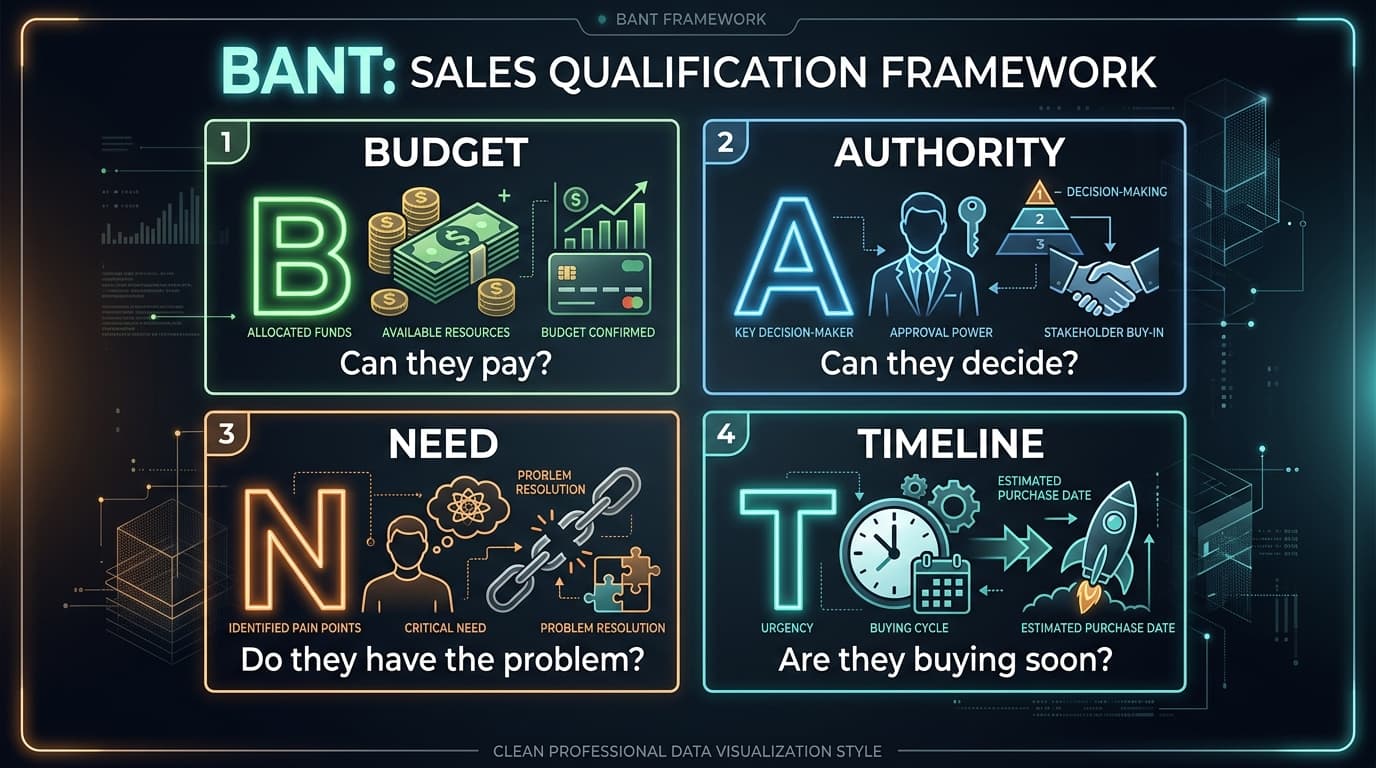
BANT is a sales qualification framework developed at IBM in the 1950s and still one of the most widely used in B2B sales. It stands for Budget, Authority, Need, and Timeline. The idea: a prospect that meets all four criteria is likely to buy. One that fails on multiple criteria should be deprioritised in favour of better-fit accounts.
What does each letter mean?
Budget: Does the prospect have the financial resources to pay for your product? This doesn't mean they've allocated a specific budget line — it means they can afford the price range without it being a material obstacle.
Authority: Is the person you're talking to able to make or meaningfully influence the buying decision? Talking to someone who can't say yes is the most common time-sink in B2B sales.
Need: Does the prospect have a genuine problem your product solves? Not a theoretical interest — an actual pain with real cost attached to it.
Timeline: Are they planning to make a decision within a reasonable window? A prospect who’s interested but has no urgency isn’t a pipeline opportunity — they’re a future pipeline opportunity. In complex deals, timeline often depends on whether the buyer still needs to run a proof of concept before they can commit, which can add weeks or months to the evaluation.
How to use BANT in a discovery call
You don't ask BANT questions in order. That feels like an interrogation. You work them into a natural conversation. Budget: "How are you typically funding projects like this — is there a budget set aside, or would this need approval?" Authority: "Who else typically gets involved in decisions like this at your company?" Need: "What's driving the urgency to look at this now?" Timeline: "If we were a good fit, what would your process look like from here?"
Where BANT breaks down
BANT was designed for enterprise sales with formal procurement processes. In modern B2B — especially SMB and mid-market — it has three real limitations:
Budget is often undefined at initial discovery. Most SMB buyers don't have a budget allocation for your specific category — they evaluate based on value, then figure out funding. Disqualifying on budget too early kills deals that would have closed.
Authority is increasingly distributed. Modern B2B buying involves multiple stakeholders. The person you're talking to might not be the final decision-maker but can be the champion who drives the deal. Disqualifying them as "not the authority" misses how buying actually works.
Timeline is often created, not discovered. Urgency is partly a function of how well the salesperson or product articulates the cost of inaction. "No timeline" sometimes means "nobody made the cost of waiting clear yet."
How AI agents apply BANT
AI SDRs apply BANT as a prospecting filter before reaching out — using company size (budget proxy), job title (authority proxy), hiring signals and tech stack (need proxy), and growth signals (timeline proxy). By the time a prospect enters the sequence, they've already scored well on all four. The discovery call confirms rather than discovers the qualification.