What is RevOps? Revenue Operations explained
RevOps (Revenue Operations) is the function that aligns sales, marketing, and customer success under a single operational framework — shared data, shared process, shared accountability. Here's what it does, why it exists, and when you need it.
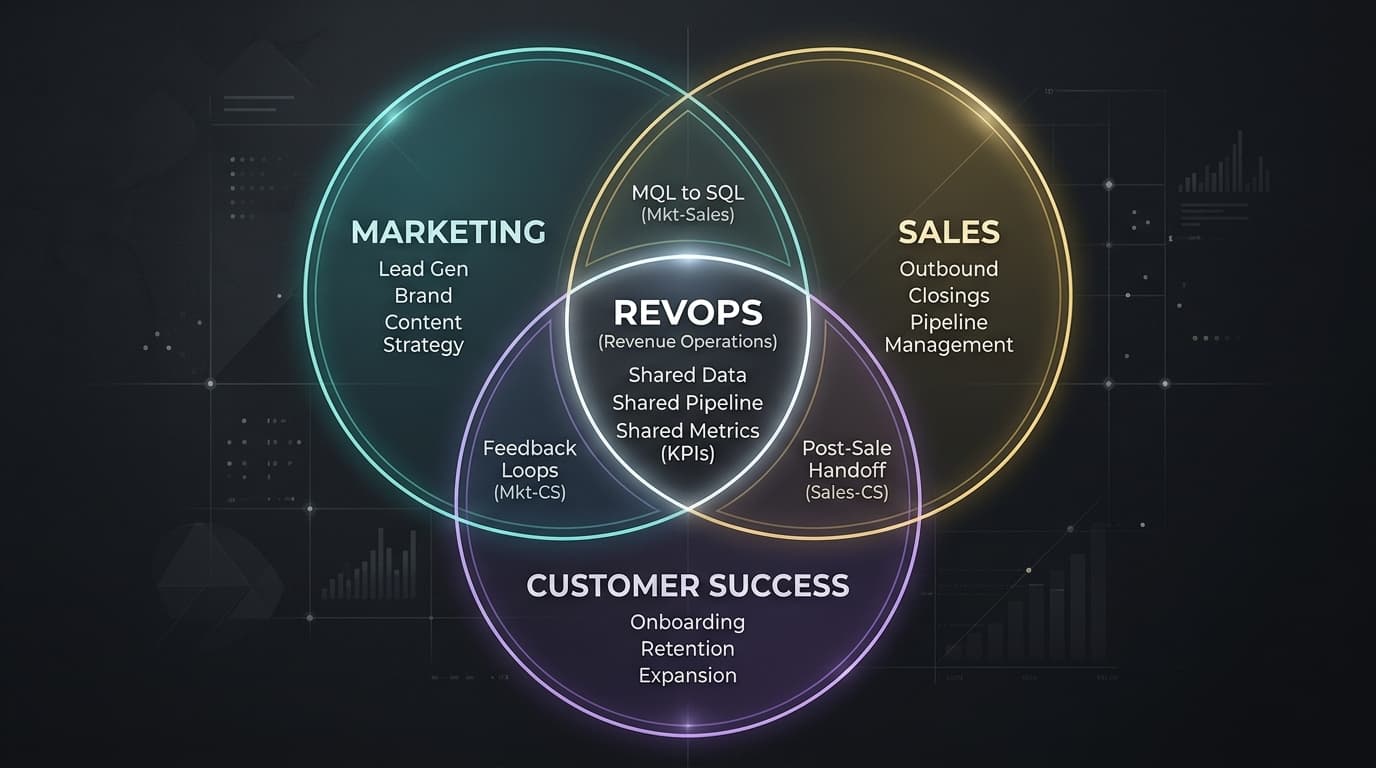
RevOps, short for Revenue Operations, is the function that aligns sales, marketing, and customer success under a single operational system. Shared data, shared process, shared metrics. The goal is to eliminate the silos that cause revenue to leak between teams — leads that marketing generates but sales can't convert, customers that sales wins but success can't retain.
Why does RevOps exist?
Before RevOps, most B2B companies ran their go-to-market functions as separate departments with separate tools, separate data, and separate definitions. Marketing defined a lead one way. Sales defined it another. Customer success had no visibility into what was promised during the sales process. Each team optimised for its own metrics and then blamed the others when revenue targets missed.
RevOps was a response to that. Poor marketing and sales alignment is one of the root causes RevOps was built to fix. It doesn't replace any of those functions. It creates the operational layer underneath them: the shared CRM data model, the handoff processes, the pipeline stages both sales and marketing agree on, the reporting that doesn't require three different spreadsheets to reconcile.
What does a RevOps team actually do?
The work breaks into four categories:
Process: defining what a qualified lead is, what the handoff between SDR and AE looks like, when a deal moves from one pipeline stage to the next, and how renewals get flagged before they churn.
Technology: owning the GTM tech stack — CRM configuration, integrations between tools, data hygiene, automation rules. Most RevOps teams spend 40-50% of their time on CRM administration.
Data: building the reporting infrastructure so leadership can see pipeline health, conversion rates, and revenue forecasts without asking three people to pull data manually.
Sales enablement: making sure reps have the content, tools, and training they need to execute — and that new hires ramp faster than they would without a structured onboarding process.
When do you need RevOps?
Most companies don't need a dedicated RevOps hire until they have at least 3-4 GTM people and a CRM that's accumulating real data. Before that, the founder or a sales lead is doing RevOps informally — setting up the CRM, defining pipeline stages, tracking what's working.
The signals that RevOps is overdue: pipeline data is unreliable, sales and marketing argue about lead quality, customer success doesn't know what was promised in the sales process, forecasting is a monthly exercise in guessing.
How AI changes the RevOps model
The most labour-intensive parts of RevOps — CRM data entry, pipeline hygiene, lead routing, activity logging — are exactly what AI agents can handle. In an AI-native GTM system, the CRM updates itself from agent activity. Pipeline stages advance based on signals, not manual drag-and-drop. That frees the human RevOps function to focus on the parts that require judgement: process design, cross-functional alignment, and revenue architecture.