Why B2B sales forecasting is broken at small companies
Small B2B companies forecast from CRM data. Their CRM data is unreliable. So their forecasts are unreliable. The problem isn't the forecasting model — it's the input quality. Here's why CRM data breaks down at small team scale and what to do about it.
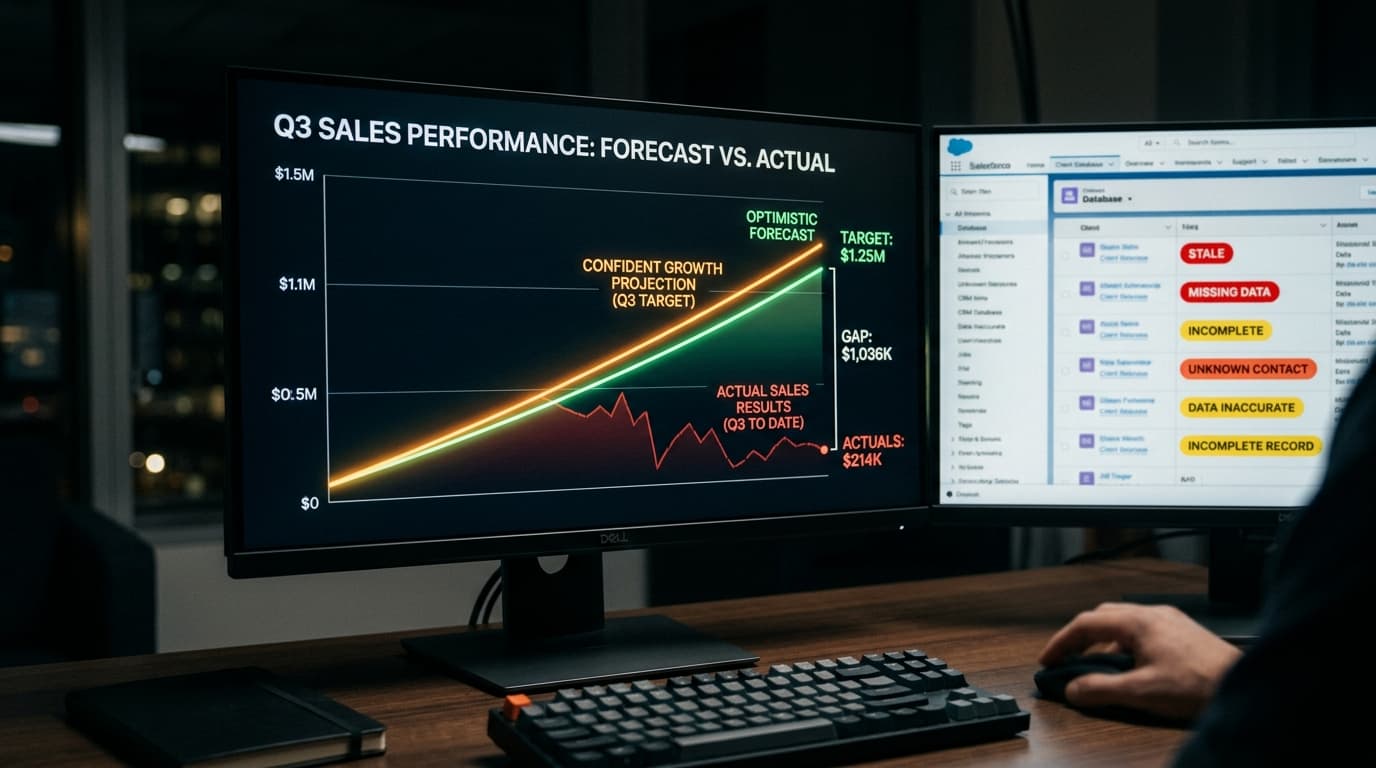
Small B2B companies forecast from their CRM data. Their CRM data is unreliable — stale deal stages, deals that moved forward without being updated, contacts whose roles changed six months ago, pipeline that was added optimistically and never cleaned up. The forecasts built from this data are unreliable. The problem isn't the forecasting methodology. It's the input.
Why is small-team CRM data unreliable?
Because maintaining it competes with selling. Every minute an AE spends updating a deal stage is a minute they're not working the deal. Every time an SDR has to log a call, send a follow-up, and update a contact record — three separate actions in most CRMs — is friction that gets skipped when the week gets busy. The data degrades not through negligence but through a structural incentive problem: the person who benefits from accurate CRM data (the manager doing forecasting) is not the person who has to enter it (the rep who's trying to hit quota).
What does unreliable CRM data do to forecasts?
It creates false confidence. A pipeline report showing $500K in the next 90 days sounds like a real number. But if 40% of those deals haven't been touched in three weeks, 20% have changed stakeholders without being updated, and 15% were added with optimistic close dates that have already passed — the real 90-day pipeline might be $150K. Acting on the $500K number means missing quota and not knowing why until it's too late to course-correct.
What are the specific failure modes in small-team forecasting?
Stage-based forecasting on stale stages. If deals advance in the CRM only when someone remembers to update them, stage doesn't reflect real deal progression. It reflects last time the rep logged in and moved things. Activity-based forecasting without activity quality filters. "High activity" on a deal that hasn't had a substantive conversation in six weeks isn't a buying signal — it's logging volume. Gut-feel adjustments without systematic signals. The manager adds or subtracts percentage points from the forecast based on intuition, which is sometimes right and has no feedback mechanism to improve.
What actually fixes small-team forecasting?
CRM data that maintains itself. When the pipeline updates automatically from agent activity — every outreach sent, every reply received, every meeting booked — the data quality problem goes away at the source. Forecast inputs that reflect real activity, not manually logged approximations of it. Forecasting then becomes a real signal rather than a best guess applied to numbers that were wrong before anyone ran the model.