Why founder-led sales doesn't scale — and what to do about it
Founder-led sales works right up until it doesn't. The founder closes deals faster than anyone they'd hire — until the company needs to grow beyond what one person's calendar allows. Here's exactly where it breaks and what actually fixes it.
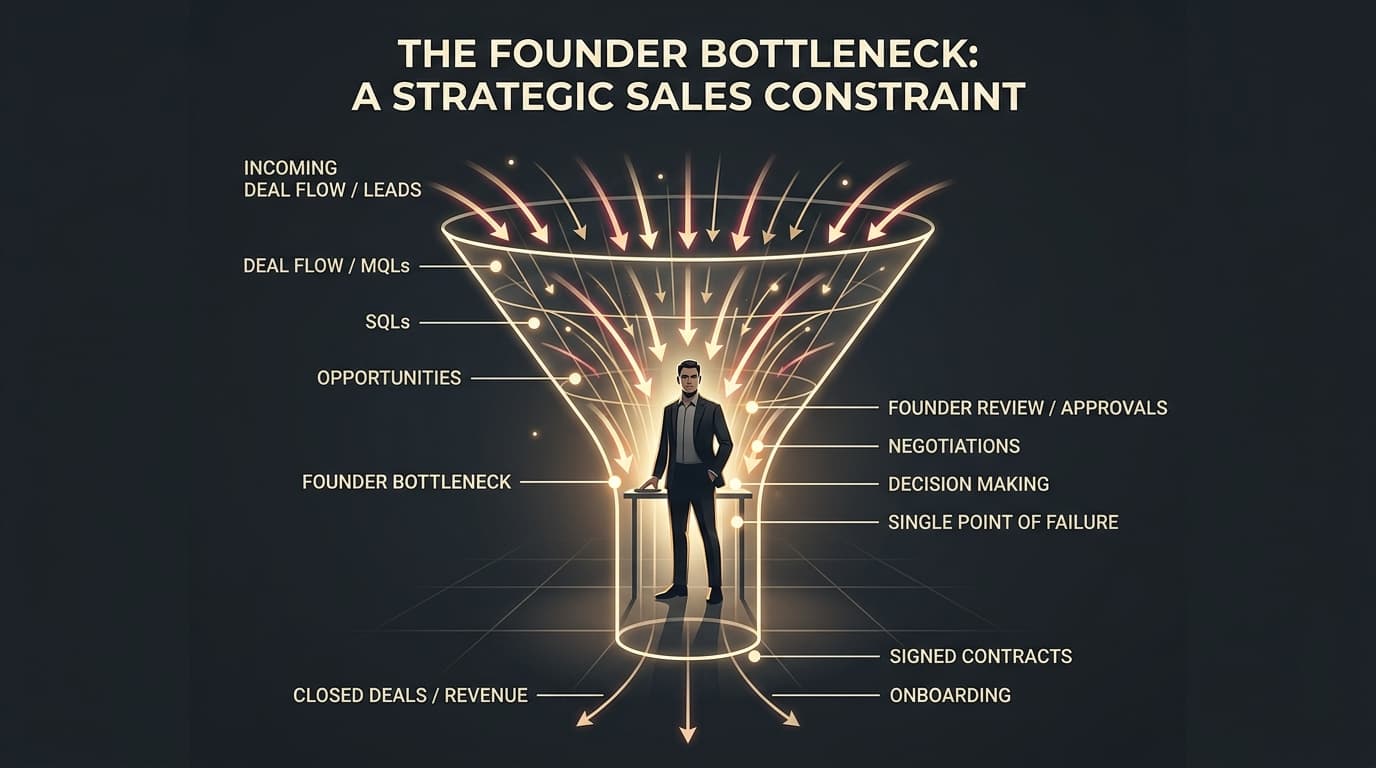
Founder-led sales is the correct default for early-stage B2B companies. The founder knows the product better than anyone, can answer any question, and closes deals faster than a new hire could in their first six months. It works — until it doesn't. The failure mode is predictable and it hits at the same point in almost every company.
Why does founder-led sales work at first?
In the early days, founder-led sales wins because of knowledge density. The founder holds everything: the product roadmap, the customer success context, the competitive angles, the objection responses. A prospect has a technical question — the founder answers it live. A deal stalls — the founder knows which lever to pull. That knowledge density is a real competitive advantage.
Where does it break?
It breaks when pipeline grows faster than one person's calendar. At some point there are more qualified prospects than available hours. Deals start slipping not because they're bad fits but because follow-up is slow, demos get scheduled two weeks out, and proposals take longer to send. The constraint isn't quality — it's capacity. The founder became the bottleneck.
The secondary failure is knowledge lock-in. Everything the founder knows about what works — the ICP nuance, the messaging that resonates with a specific vertical, the objection that kills deals at the proposal stage — lives only in their head. When they hire an SDR or AE, the handoff is imperfect. The new hire learns slowly from real calls, re-makes mistakes the founder already solved, and the ramp time is long because the institutional knowledge was never written down.
What doesn't fix it?
Hiring an SDR before the message is proven doesn't fix it — it accelerates activity without improving outcomes. Adding a CRM without changing how decisions get made doesn't fix it. A sales manager who inherits a founder-dependent process just adds a layer on top of the same bottleneck.
What actually fixes it?
Two things. First, structured sales enablement — capturing the playbook, the ICP definition, the messaging that works, the objection responses, the close pattern — in a form that survives the founder stepping back. Second, building a pipeline motion that runs without the founder initiating each cycle. Outbound that runs daily whether or not the founder shows up. Follow-up that happens automatically. The founder's role shifts from operator to coach — setting direction, reviewing outcomes, adjusting strategy. The execution runs underneath.