B2B outbound benchmarks 2026: open rates, reply rates, and meetings booked
What does good B2B outbound performance look like in 2026? Benchmarks for open rate, reply rate, positive reply rate, meetings booked, and SDR productivity — broken down by segment and approach.
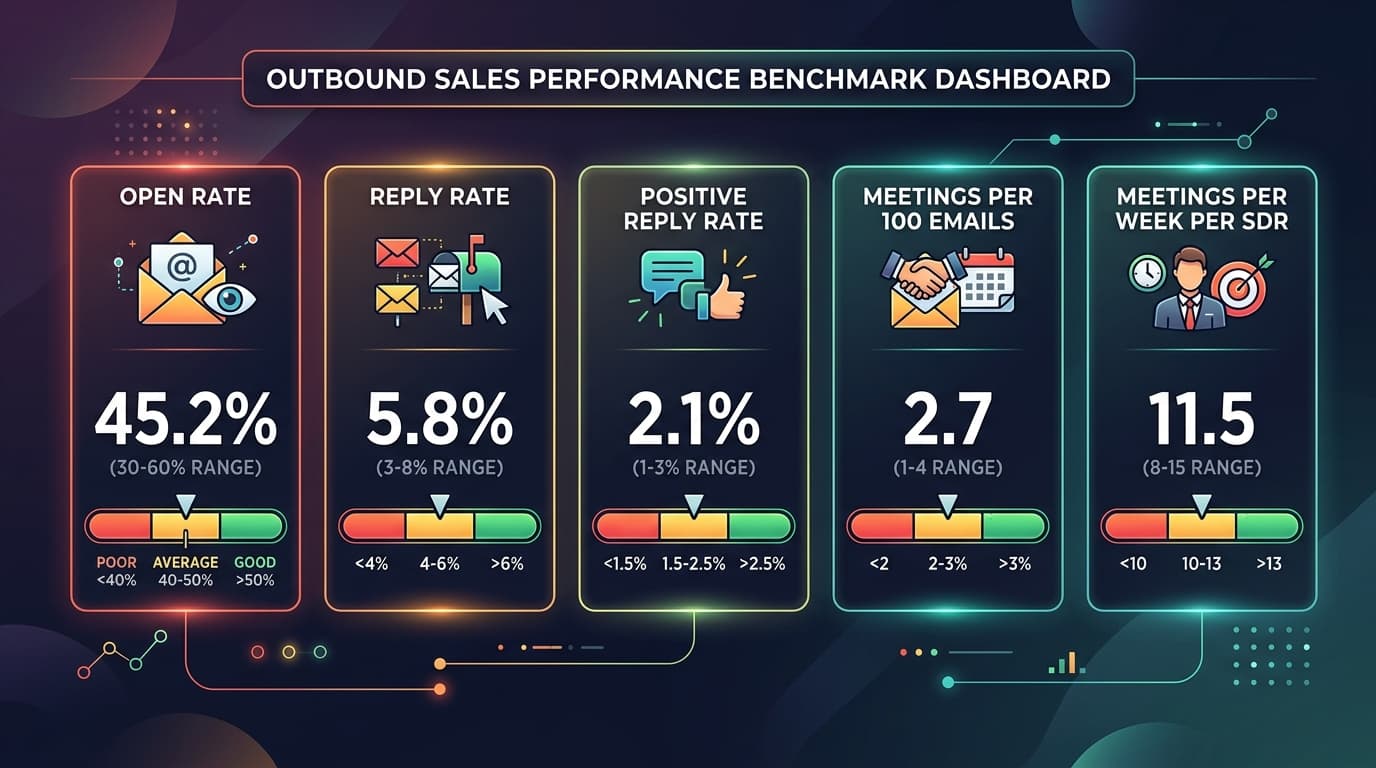
Most outbound benchmarks are either outdated or averaged across thousands of campaigns that include genuinely bad outreach. These figures reflect what competent outbound — a tight ICP, a researched first touch, a full 5-step sequence — actually produces. Where relevant, we've noted patterns from outbound sequences run through Ektie's AI SDR agents to give you a comparison point between human-operated and AI-operated motions.
What open rate should you expect?
Good: 40–60%. Average: 25–40%. Below benchmark: under 25%.
Open rate is a function of deliverability and subject line. Below 25% is almost always a deliverability problem — emails landing in spam or promotions. Check SPF/DKIM/DMARC configuration, sending domain reputation, and volume ramp. If deliverability checks out but opens are still low, the subject line isn't earning the open. Subject lines under 6 words consistently outperform longer ones in Ektie sequences — brevity reads as confidence.
What reply rate should you be hitting?
Good: 5–8%. Average: 3–5%. Below benchmark: under 3%.
Four failure modes account for most below-benchmark reply rates: message over 150 words, ICP too broad so the message reads generic, ask too high as a first touch, or pain framing that doesn't match what the prospect actually feels. Across sequences Ektie has run for healthcare buyers, switching from ROI framing to compliance framing on the same ICP segment typically doubles the positive reply rate — the pain angle matters as much as the targeting.
What counts as a good positive reply rate?
Good: 2–3% of sent. Average: 1–2%. Below benchmark: under 1%.
Positive replies are those expressing genuine interest. The ratio of positive to total replies should run 30–50%. High total reply rate with low positive rate means one of two things: the right companies, wrong person — or the message angle is triggering a polite deflection instead of a real response.
Meetings booked per 100 emails sent
Good: 3–4 meetings. Average: 1–2 meetings. Below benchmark: under 1 meeting.
This is the only output metric that matters. Open rate, reply rate, positive rate — all diagnostic. Meeting rate tells you whether the full funnel works. 3–4 per 100 requires a well-defined ICP, a tight message, and a full 5-step sequence. Campaigns missing this number have one of two problems: ICP is too broad, or sequences are cut short before the follow-ups do their job.
Where replies actually come from in a sequence
This is where most people are leaving pipeline on the table. In sequences run through Ektie's SDR agents, the distribution of positive replies by step looks like this: Step 1 gets the most opens but the lowest conversion. Steps 3–4 generate the majority of positive replies — usually 50–60% of all positive responses in a 5-step sequence. Step 5 (the break-up) generates a disproportionate final spike, typically 15–20% of positive replies, from prospects who were interested but kept deferring.
If your sequence stops at step 2, you're walking away before most of your potential replies arrive.
What should a fully ramped SDR produce per week?
A human SDR running a sequencer sends 50–100 emails per day, adds 20–50 new prospects per week depending on research depth, and books 8–15 meetings per week at full ramp. Expect 3–4 months before hitting those numbers consistently.
How do AI SDR benchmarks compare?
Ektie's SDR (Morgan) runs 24 heartbeat cycles per day. Each cycle processes 5–10 new accounts and manages sequences for 50–500 active prospects simultaneously. That's 120–240 new accounts researched and added daily — versus 20–50 for a human SDR working a full week.
The reply rate benchmark stays the same — 3–8% for quality outreach to a well-defined ICP, regardless of whether a human or AI wrote it. The difference is volume, consistency, and compounding. No ramp period. No Mondays. No drift when the quarter gets hectic.
What changed in 2026
Reply rates are under pressure. The benchmark floor dropped from 5–10% in 2023 to 3–8% today. Inboxes are louder, and prospects can recognise AI-generated outreach faster than they could two years ago. The practical implication: ICP specificity and a researched first line are no longer differentiators — they're table stakes. Generic sequences at volume get filtered out. A tight ICP with one specific observation about the prospect's company still converts. For a full breakdown of the outbound metrics that matter most in this environment, see the dedicated metrics guide.