How to structure a B2B sales team for a startup
Most startups structure their sales team in the wrong order — hiring AEs before the ICP is proven, adding SDRs before the message works, or building management layers before there's a team to manage. Here's the sequence that actually works.
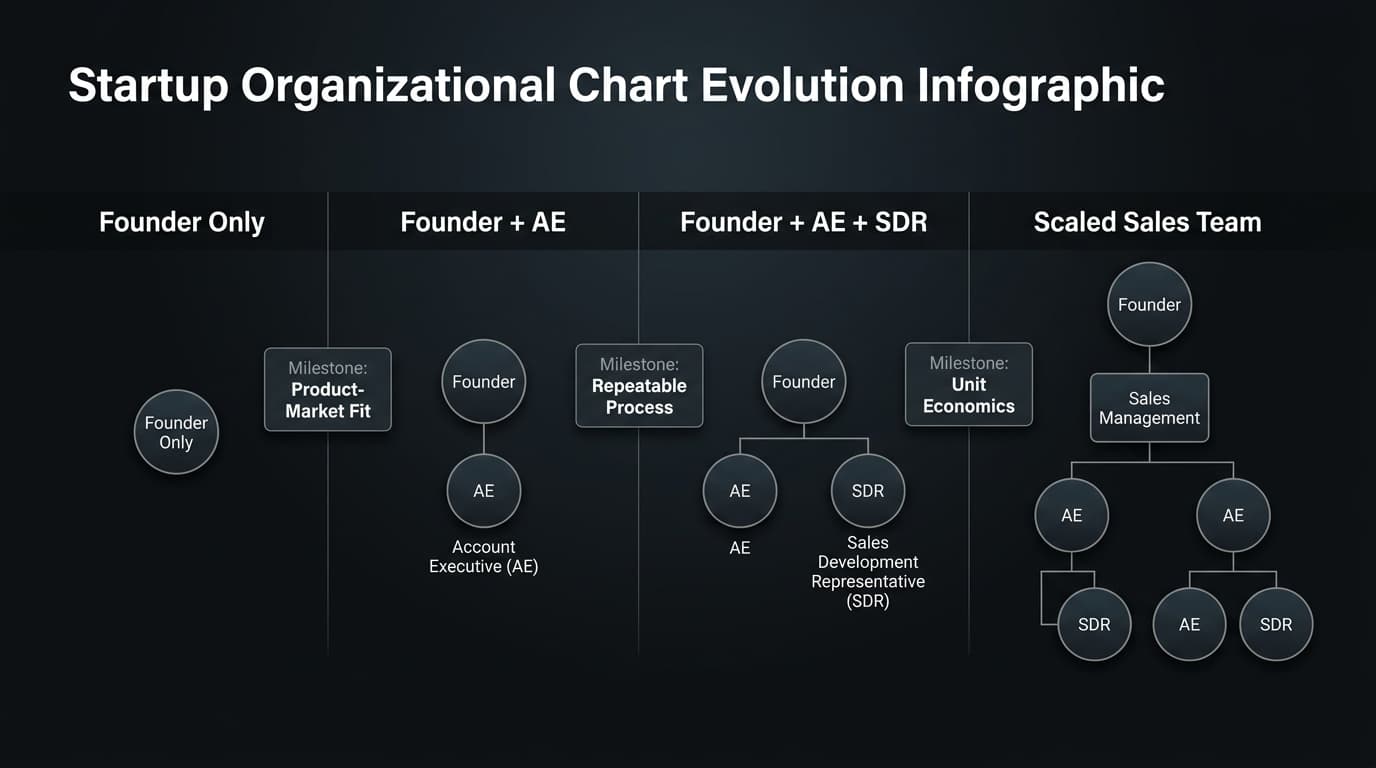
Building a B2B sales team is not about adding headcount in a logical-looking sequence. It's about hiring into proven motions. The startups that get this wrong hire AEs before the ICP is solid, add SDRs before the message converts, or bring in sales management before there's a team to manage. The sequence matters as much as the roles.
Stage 1: Founder-led (0 to first 10 customers)
The founder does all GTM. Outbound, demos, closing, onboarding, customer success. This is the right model at this stage — the founder learns what works, what the real objections are, which ICP actually buys, and what the winning message sounds like. No hire can replace this learning. The goal isn't efficiency — it's understanding.
Stage 2: First AE hire (10–30 customers, proven ICP)
The first sales hire should be a junior-to-mid AE who can run a demo and close a deal with the founder's playbook. Not a VP of Sales, not a sales manager — someone who executes what the founder has already proven works. The founder transitions from closing to coaching: this is where sales enablement becomes critical — handing over the playbook, reviewing calls, and improving the process so the AE ramps without re-learning everything from scratch. If the new AE can't close with the playbook, the problem is the playbook, not the hire.
Stage 3: SDR hire (pipeline volume problem)
The SDR comes after the AE, not before. By this point, the AE is running demos and closing, but the pipeline isn't filling fast enough. The SDR's job is to generate qualified meetings using the proven message. Critical: the SDR should be executing a defined playbook, not discovering one. If they're discovering the message, it's too early.
Stage 4: First sales manager or head of sales
Sales management makes sense when there are 3–5 reps and the founder can no longer provide coaching and deal support to all of them. The first sales manager is usually a player-coach — carrying a quota while managing a small team. Pure management layers before team size justifies them add overhead without output.
What does AI change about this sequence?
AI agents compress Stage 1 and Stage 3. In Stage 1, an AI SDR can run outbound at volume while the founder focuses on closing — accelerating the signal gathering that used to require manually doing everything. In Stage 3, an AI SDR handles the pipeline-volume problem without the ramp time, management overhead, and attrition risk of a junior SDR hire. The human team builds on top of a motion that's already running.