The complete B2B outbound guide
B2B cold outbound works when it's done consistently, with the right ICP, the right message, and a sequence that follows through. This guide covers every component — from ICP to metrics — and how AI makes the whole motion run without you.
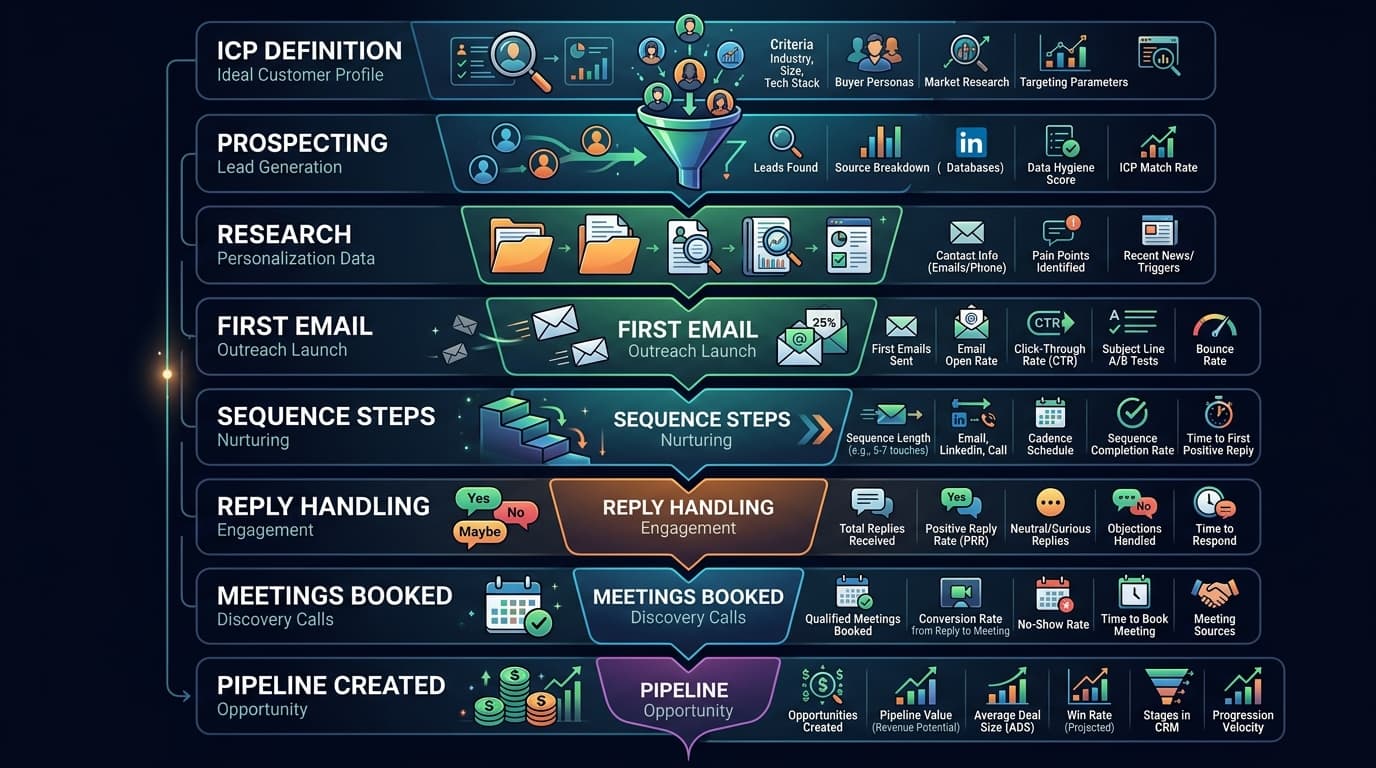
B2B cold outbound is one of the most reliable ways to generate pipeline — and one of the most consistently misexecuted. It works when four things are true simultaneously: the ICP is specific enough to generate a targeted list, the message speaks to a real pain, the sequence follows through long enough to get replies, and the motion runs consistently without stopping when things get busy. Most companies get one or two of those right. This guide covers all four.
Part 1: The ICP — everything starts here
The ICP (Ideal Customer Profile) is the foundation of outbound. It defines who you're targeting at the company level (industry, size, geography, funding stage, tech stack) and the contact level (role, seniority, decision authority). Every downstream decision — who to find, what to say, which channel to use — flows from the ICP.
A usable ICP fits in one sentence: "We sell to [role] at [company type], [size], who are experiencing [specific problem]." If it takes more than one sentence, it's too broad for outbound.
Build your ICP from your best existing customers, or from first-principles hypothesis if you're pre-customer. Test it with a batch of 50–100 outreach messages. The data tells you where to narrow or expand.
Part 2: Prospecting — how do you build a list worth sending to?
B2B prospecting uses structured databases (Apollo, ZoomInfo, LinkedIn Sales Navigator) to find companies and contacts matching the ICP. The quality of the list directly determines the quality of the outreach. A tight list of 100 well-matched prospects outperforms a broad list of 1,000 every time.
For each prospect, gather: company name, size, industry, the specific contact's name, title, and one specific detail about their company or role that you can reference in the first line of the email. That one detail is the difference between an email that feels personalised and one that feels templated.
Part 3: The first email — one job only
The first email has one job: get a reply. Not explain the product. Not list features. Not close the deal. Just get a reply from someone who might be interested. Structure: one personalised opening referencing something specific, one sentence on the problem you solve, one low-friction question. Under 100 words. Subject line under 6 words and specific to the prospect.
The most common mistake: writing the email you want to send instead of the email they want to receive. They want to know: is this relevant to me, is this person credible, what do they want from me? Answer all three in under 100 words.
Part 4: The sequence — 5 steps, different angles
Most replies in B2B outbound come on the 3rd to 5th touch. A 5-step sequence over 18–21 days captures the majority of potential pipeline. Step 1 (Day 1): first personalised email. Step 2 (Day 4–5): LinkedIn touch. Step 3 (Day 7–8): follow-up with a different angle (case study, relevant insight, pain reframe). Step 4 (Day 12–14): soft check-in. Step 5 (Day 18–21): break-up email.
Each step should offer a new reason to reply — not just "following up on my previous email." The break-up email consistently generates a reply spike from prospects who were interested but kept deferring.
Part 5: Metrics — five numbers that tell you everything
Prospects added per week (top of funnel health), open rate (30–60% benchmark), reply rate (3–8% benchmark), positive reply rate (1–3%), and meetings booked (1–4 per 100 emails). Track these weekly. Diagnose sequentially: if a metric is off, fix that layer before optimising downstream. Tracking pipeline coverage alongside these funnel metrics tells you whether the volume coming in matches what you need to hit revenue targets.
Part 6: Why outbound dies — and what actually keeps it running
The strategy above works. The execution problem is consistency. Outbound requires daily inputs — new prospects, new sequences, replies handled. When a founder gets pulled into product, a rep gets busy with demos, or the quarter gets hectic, outbound stops. Pipeline dries up 60 days later.
Outbound compounds only when it runs continuously. The teams that actually sustain it have solved this one way or another — a dedicated SDR, a process strict enough to survive a busy quarter, or an AI agent running sequences on its own schedule. The method matters less than the outcome: outbound that doesn't stop.
Go deeper on any component
Each section of this guide has a dedicated post: what an ICP is and how to build one from scratch; what a sales sequence is and how to structure one; how to write a cold email sequence that gets replies; what a good cold email reply rate actually looks like by stage and ICP quality; how many follow-up emails before giving up; and how to set up B2B outbound from zero — infrastructure, list, first batch.