What outbound sequences taught us about B2B reply rates
Based on outbound sequences run through Ektie's agents, here's what the data shows about B2B reply rates — what moves them, what kills them, and which variables matter most.
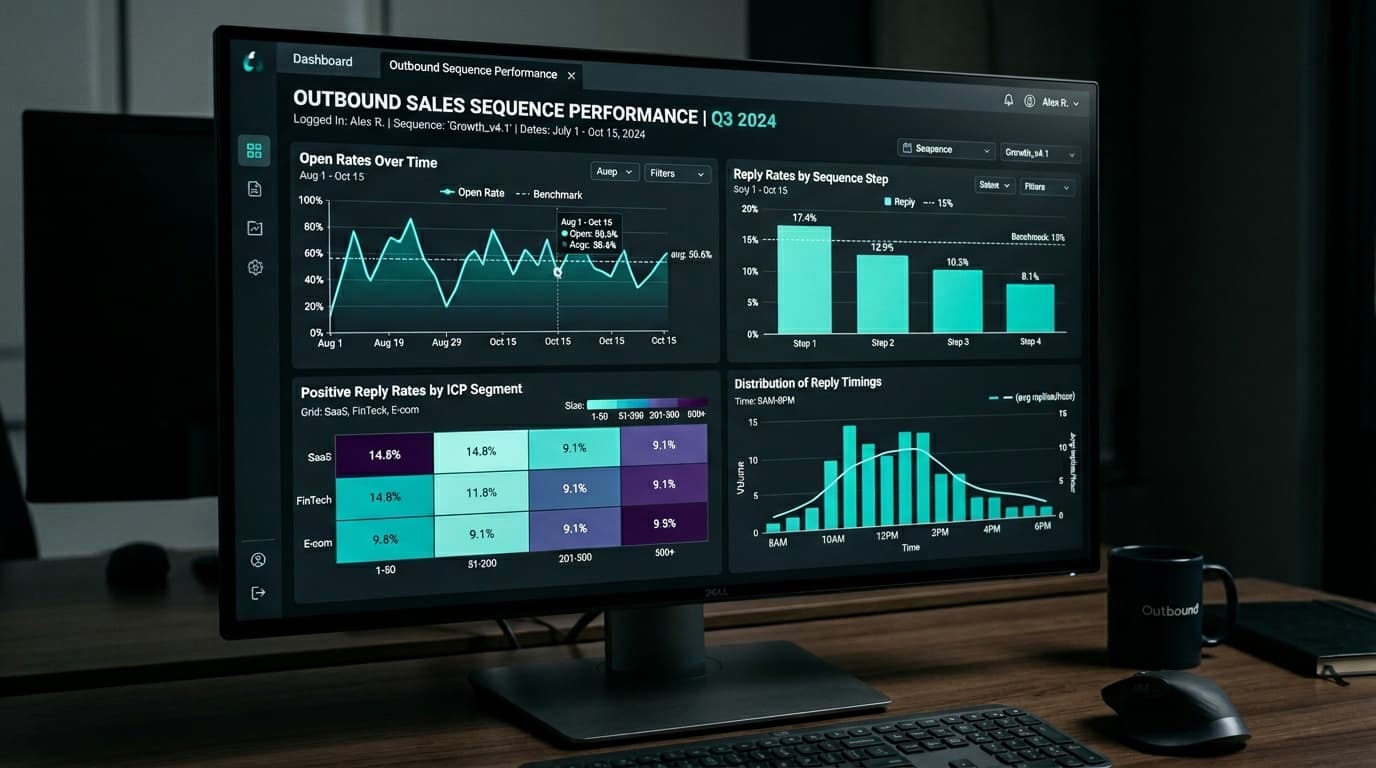
Most B2B outbound benchmarks are either outdated or based on self-reported data from salespeople who have every incentive to round up. Based on sequences run through Ektie’s outbound agents across B2B SaaS, professional services, and agency verticals, here’s what the numbers actually look like — and more importantly, what moves them.
What is a realistic B2B reply rate in 2026?
Across sequences run through Ektie’s agents, the median reply rate for cold outbound to a well-defined ICP is 4–6%. Sequences targeting a loosely defined ICP — broad industry, generic role, no research — land at 1–2%. Sequences with tight ICP and account-level research hit 8–12%. The gap between top and bottom quartile is almost entirely explained by targeting specificity, not message quality.
Which sequence step generates the most replies?
Step 1 (initial outreach) generates roughly 25–30% of positive replies. Steps 3 and 4 generate 45–55% combined. The break-up email at Step 5 consistently generates 15–20% of positive replies — prospects who opened multiple prior emails but hadn’t replied. The implication: stopping at Step 2 or 3 leaves the majority of pipeline unreached. Full sequences to Step 5 significantly outperform truncated ones.
What time of day and day of week matters?
Across sequences run through Ektie’s agents, Tuesday through Thursday sends consistently outperform Monday and Friday by 20–30% on reply rate. Morning sends (7–9am recipient timezone) outperform afternoon sends. The difference is real but not dramatic — a well-targeted email sent on a Friday still outperforms a generic email sent on a Tuesday.
What personalisation actually moves reply rate?
Account-level research (a specific signal about the company — job posting, funding, content, tech stack) improves reply rates by 2–3x over pure template sends. Adding the contact’s first name and generic role reference (“as a VP Sales”) does not move reply rates meaningfully. The delta is in account-specific signals, not personalisation tokens. One real research point is worth more than five placeholder variables.
What does ICP tightness do to reply rates?
The single highest-leverage input. Sequences to a well-defined ICP (specific company size, specific role, specific situation) consistently hit 2–3x the reply rates of broad-ICP sequences at the same message quality. The implication for teams optimising outbound: ICP sharpening returns more than message testing until the ICP is genuinely tight.