GTM from zero: the founder's guide to go-to-market
Most founders build GTM the same way: manually at first, then hire, then realise the team can't sustain itself without them. This guide covers every stage of building GTM from zero — and how to avoid being the bottleneck at each one.
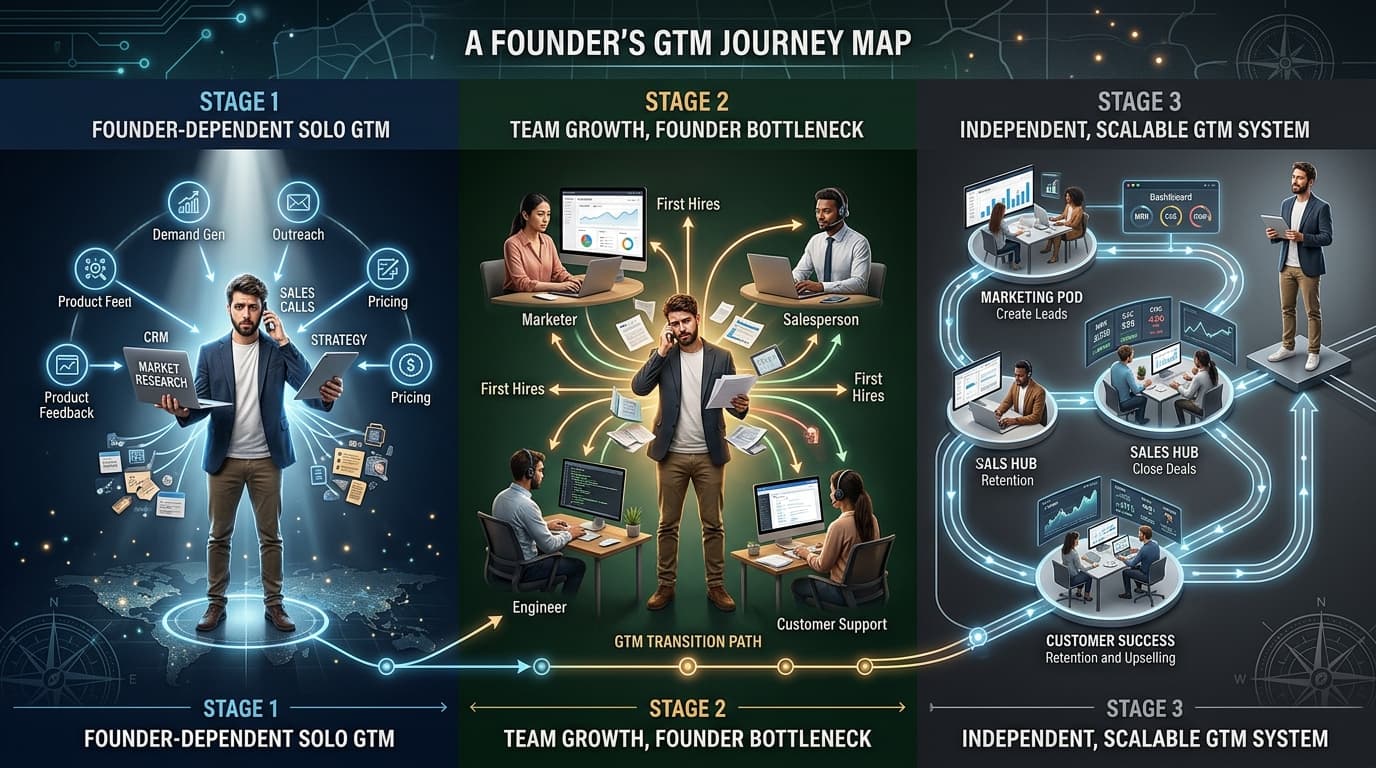
Most founders build GTM the same way: do everything themselves until they get early customers, hire a few people, then realise the team still can't run without them. The founder is always the bottleneck. At every stage, context routes through one person. The moment they step away, things stall.
This guide covers every stage of building GTM from zero — what to do, what to avoid, and what has to change at each stage before you can move to the next one.
Stage 1: Zero to first 10 customers (founder-led)
Do everything manually. Talk to potential customers constantly. Close deals yourself. The goal isn't efficiency — it's information. You're learning who buys, why they buy, and what language they use to describe their problem. That knowledge is the foundation for everything that follows.
What to document as you go: the ICP (who bought fastest, who's happiest), the message that generates replies, the objections that come up repeatedly, and the questions that reveal a real fit in the discovery call. This is your nascent sales playbook.
Stage 2: How do you know the ICP and message are right?
Before scaling anything, turn your learnings from Stage 1 into a documented ICP. One sentence: who you sell to, at what size company, experiencing what specific problem. This single sentence filters every downstream decision.
Then write the core messaging: the problem in buyer language, the mechanism you use to solve it, and one believable outcome. Test it with 50–100 outbound emails. Track open rate, reply rate, and meeting rate. If reply rate is below 3%, the ICP or message needs to change. If above 6%, you've found something.
Stage 3: What does a working outbound motion actually look like?
Once the ICP and message are validated, build the outbound motion: prospecting sources, a 5-step sequence with varied angles, a sending infrastructure (secondary domain, SPF/DKIM/DMARC, warmed inbox), and a CRM to track pipeline.
The bottleneck at this stage: the founder is still feeding the top of funnel. They build the list. They write the first email. They review replies. When they get busy, outbound stops.
Stage 4: The first hire — or the alternative
At this stage, most founders hire a junior SDR. The SDR costs $55,000–$80,000 all-in, takes 2–4 months to ramp, and needs the founder to transfer the context that currently lives in their head. For a few months, the bottleneck gets better. Then if the SDR leaves (highly likely in year one), you start over.
There's a better sequence. Run an AI SDR first to get the motion running and documented — sequences, reply handling, objection patterns — then hire a human SDR into a system that already works. The AI creates the playbook the human SDR inherits. Ramp time drops from 3 months to 3 weeks because there's a documented, running process to hand off.
Stage 5: Why does GTM knowledge keep disappearing?
By Stage 5, you have an SDR, an AE, a marketing function. The new bottleneck is coordination. The SDR books a meeting, the AE shows up with incomplete context. Marketing runs content the ads team never sees. The director coaches the SDR once, it's forgotten by next sprint. The team is in the building. The knowledge isn't shared.
This is the coordination problem most GTM teams never solve. Every coaching note, won deal pattern, and ICP refinement gets made — then lost. It lives in a Slack thread, a call recording nobody rewatches, or the head of whoever ran that sprint. The fix is structural: a single place where GTM memory is written down and referenced every cycle. Not a wiki that collects dust. A live document that every rep and AE reads at the start of each sprint as standard operating procedure.
Stage 6: What makes GTM self-sustaining?
A self-sustaining GTM has three properties: execution runs without the founder prompting each step, knowledge compounds instead of resetting, and the loop closes (outcomes from each cycle inform the next). Most teams achieve the first inconsistently, rarely the second, almost never the third.
Dive deeper
What is a GTM strategy — components, motions, and failure modes. Why GTM teams fail to sustain themselves — the structural reason the loop never closes. Building is solved, distribution is the new bottleneck — what changed for founders. What is an ICP — definition and how to build one. Inbound vs outbound sales — understanding the two main acquisition motions before you choose one. How to set up B2B outbound from zero — the full process. The solo founder's guide to outbound — what works without a team. Founder-led sales — how to stop being the bottleneck in your own pipeline. Before your first hire — when to hire an SDR vs run AI outbound first. What is a sales playbook — and how to keep it current.